Join us as we delve into the Carve Classic archives for some all time trips and interviews, we caught up WA resident Jordan Rodin, to talk the joys of a finless craft. Originally featured in issue 188.
Interview by Steve England Photos by Billy Cervi
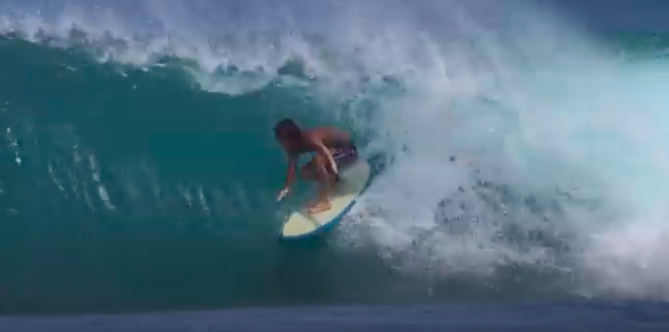
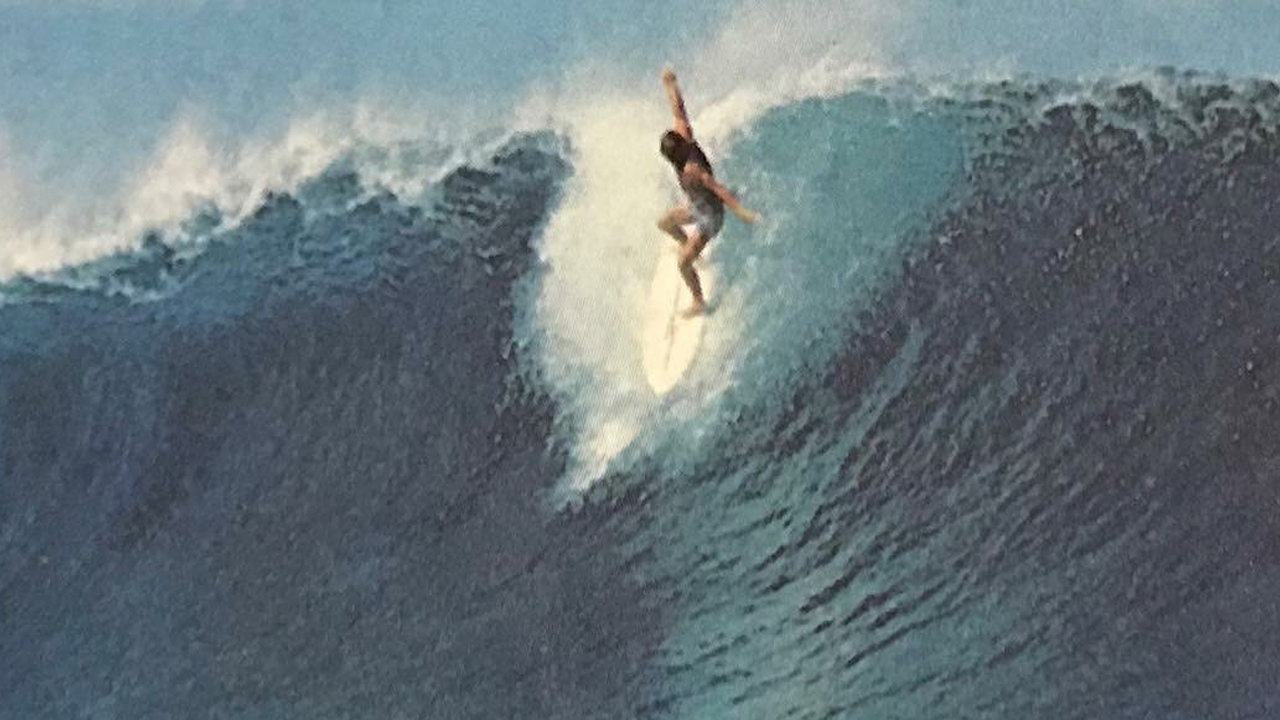
Every now again you get a random “Wait, what…?” shot through the email that stops you in your tracks. A bottom turn by 24-year old WA resident Jordan Rodin, on a finless craft, did just that this month. He’s full tilt, laid over, only the last third of rail left in the water for drive on one of Derek Hynd’s Far Field Free Friction designs. How did he do that, what was going on? Steve England found out…
This is what I love most about Free Friction Surfing; there are no shortcuts!
So, that’s pretty much the best bottom turn shot I’ve seen since Hynd went on our cover … How do you keep the board in the water when you are so on edge?
Oh wow, big call Steve! Thank you! Well speed and momentum is a great sticky thing. The speed of free friction off the bottom is so great once you lay your board on rail and hold it in the right line there is no slip. The rail sticks to the wall of the wave through speed and carry.
What made you take up FFFF?
At the time I just forgot my fin one day down at the beach, but I believe I was bored with my surfing and it happened organically.
A lot of groms have got into the friction free vibe since mini-foamies came out. What advice do you have for anyone who wants to take it up technique wise. Have you got any magic shortcuts?
This is what I love most about Free Friction Surfing; there are no shortcuts! I spent the first six months of free friction eating shit, but I would say minimize everything you do on the wave and just trim.
I read the only down fall is you can’t go backhand so well on these craft. Is that so, if so why?
In my opinion backside has a high and low. It works wonders when the waves are hollow and you can adopt a tradition pig-dog stance, but when the waves are flatter rails and get sticky and easy to slip. I took a trip north last year up to Red Bluff to learn more about backside and I proved myself wrong on what you can pull off, which was exciting. I think that’s the future for FFFF.
On the other side of the coin foils have started to raise their heads and it seems riders are describing a friction free feeling too. Have you had a go?
No, I haven’t those things look really scary ha ha! And I don’t think I even have a wave around West Oz that would suit it. It’s all pretty dumpy around here, but I can imagine the glide speed would be insane.
Can you ride these things in deep pits. You must really have to have Jedi skills to keep an edge behind the curtain?
Yeah, you can ride the barrel for sure both frontside and back. It’s more the right style of wave you have to look for, rather than snap stall or arm drag in them. You want to backdoor the section and use the FFFF speed to your advantage.
Do you ride these all the time now? The only minus I would see is that it is fun to fully extend on a bottom turn, and actually getting air, which I think you were really good at, is pretty fun too, but your probably not going to do many of these without fins?
I have been riding without fins now for a little over a year, as far as airs go not really, I have landed minuscule airs off reverse sections but would never call it an air. I am just happy going really fast ha ha.
Have you gone FFFF at the Box or North Point?
Yeah I have surfed North Point a bunch of times, never huge, but a fun size. I definitely want to try some more days out there. I haven’t popped the Box cherry yet.
What is in your present quiver, I guess its pretty interesting, why do yo like each board and which boards do you ride most of percentage wise?
I’m lucky enough to have three FFFF crafts in my quiver: a fish, shortboard and a step up. All under Derek Hynd’s name and helped by Des Sawyer and Mike Myers. Lately I have been enjoying the fish. There’s something about going really fast on a bigger wave with a small board you can’t beat!
What is the key to a good FFFF board?
Hard rails and no short cuts!
The WSL has been making good use of the pandemic shutdown to work on changing up the tours moving forward.
Erik Logan, the WSL CEO, has announced a raft of changes in a vid on the WSL site for next year’s comps. The main takeaways are, apart from this year’s events being postponed until end June, including the Oi Rio Pro, follow:
The world title will, from 2021, be decided by a surf off.
Inspired by the epic Italo v Gabe showdown last year at Pipe from next season the title won’t be decided by consistency through the season. The men’s and women’s world title will be decided in a single day of competition in a surf-off format. Seeding will, of course, play a part. The higher your seed the more the advantage, as you’d hope. As to dominate all year to get shafted by one bad day does seem a tad harsh. More details will follow. (EDIT: it wasn’t clear in the video how many surfers would be involved but from Conner Coffin’s comment in the press release just received if it’s just the top two then it’s basically a chance for the No2 in the season to gazump the No1.)
The Challenger QS event series will now be a direct feed for the same season’s CT events.
The biggest QS events will be grouped at the start of the season allowing the best guys onto the CT in the same season. So no more doing a year in purgatory if you fall off tour. The QS, with the inevitable travel restrictions and flight costs soaring, in its current form is likely to be unsustainable so this makes a lot of sense. It makes those QS events far more exciting and interesting for the punters too.
Regional QS system to replace lower end events.
Again, with sponsorship drying up and travel costs escalating, the smaller events will be tricky. So the development tier, as E-Lo calls it, will become a regional affair. Much like the Euro tour is already. But this makes the travel requirements a lot easier. Compete in your home area to qualify for the Challenger series and from there be in with a shot at the big leagues.
All in all some interesting ideas which fit with how the world will be once we come out the end of this whole kerfuffle.
–PRESS RELEASE–
Due to the continued evolution of the COVID-19 pandemic, the World Surf League (WSL) is postponing or canceling all events, at all levels of competition, through the end of June. The WSL will continue to monitor the situation and make the next call in early June.
In a video released on all WSL Channels today, WSL’s CEO Erik Logan said to fans: “Where and when we will run this year is still very much an open question, but we will continue to work with governments, world health authorities and our local communities on returning to the lineup.”
“That said, we are extending the postponement of all WSL events through June. This means the scheduled Championship Tour stop in June, the Oi Rio Pro, is officially postponed in hopes that travel conditions ease enough to run this year. Our ‘Next Call’ update for the 2020 Championship Tour season and all our events will be on June 1.”
The WSL has also announced an evolved Tours and Competitions format for 2021 covering the Championship Tour, the Challenger Series, and the Qualifying Series.
In the video, Logan also said: “Prior to COVID-19, we had been working hard on how we would evolve the Championship Tour, the path to the CT, and all our tours in 2022 and beyond. The more we worked on this transformation, the more we became excited and it became clear that our pause due to COVID really allowed us to see that now is the time to accelerate these changes.”
Starting in 2021 the women’s and men’s World Titles will be decided in a single day of competition on the last day of the Championship Tour season, with the top surfers battling for their respective titles in a new surf-off format. This evolution has been part of a multi-year discussion, and the final design is a collaboration between the surfers, partners, and the WSL.
Two-time WSL Champion, Tyler Wright, said, “I feel like the new format raises the intensity of the entire World Title situation. The difference is that you get to win in the water, which is huge! It comes down to nobody else, and that kind of intensity, that kind of competitive pressure, raises the bar. It’s pretty exciting!”
“The world title being decided in the final, between two surfers in the running, is super exciting,” said WSL Surfer’s Representative, Conner Coffin. “I was glued to Pipe last year on the last day. So it’s a great moment for the sport and it’s exciting to think that from 2021 onwards that will always be how the world title is decided.”
In addition to the redesign of the Championship Tour (CT), the schedule will be updated to create distinct seasons between the CT and the Challenger Series. This update will not only provide an enhanced showcase for the surfers, but also allow those who fail to requalify through the CT the opportunity to perform on the Challenger Series and requalify for the elite CT the very next season as opposed to waiting an entire year.
“With the Challenger Series at a different time of the year you can highlight the up comers, you can highlight who is in the Challenger Series, you can highlight what’s new, who is coming up that is fresh, who is requalifying, and the people that drop off the CT will have an opportunity to go on and completely focus on the Challenger Series,” continued Wright.
Increased weight and value will also be given to regional Qualifying Series events to encourage up-and-coming surfers to develop closer to home without financially overleveraging themselves before jumping to the Challenger Series and beyond. The regional series will provide increased opportunities to celebrate regional stars, reduce economic pressure for surfers and sponsors, as well as drive media interest around those athletes.
“We’ll have more details soon but we’re really excited about what this means for surfers and surfing worldwide. We are approaching these updates and evolutions as holistically as possible,” said Logan. “Working with our entire community, we know we are going to emerge through this pandemic with a strong, exciting platform that propels professional surfing, and all surfing, forward in a positive and impactful manner.”
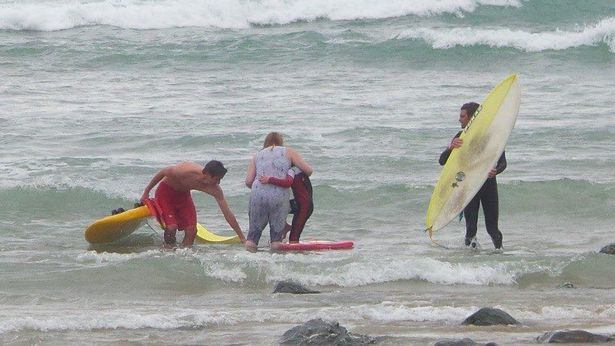
Imagine this scene if lifeguards hadn’t been there. Pic Nicky Willows
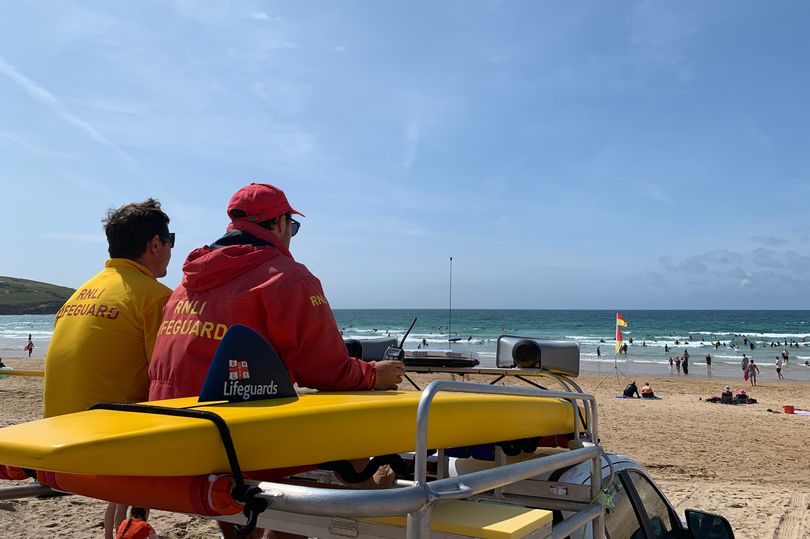
The RNLI is in a tough spot at the moment. Hundreds of highly qualified and experienced beach lifeguards returned to the UK or left winter jobs expecting to start work managing the UK’s beaches and keeping hordes of holidaymakers and those less ocean savvy safe. Unfortunately, their return coincided with the shutdown, but as seasonal workers, they weren’t apparently qualified for furlough. The RNLI bosses, already in a tough position seeing their charity donations drop, issued apologies but had to cancel contracts and promises of jobs. The result, unguarded beaches and a lot of highly qualified lifeguards out of pocket and wondering what comes next.
Right now on many beaches (where it is legal to surf) many surfers (some guards or ex-guards, some just salty sea dogs) are already issuing verbal warnings on tidal cut off to walkers or asking more ‘adventurous’ (I’m being kind) visitors to the coast not to swim in rips, climb rocks and even raising more serious alarms. It’s not the surfers’ job, but it is one that most the front line services – police, RNLI, Coastguard – are often grateful for. But surely even in lockdown resorts and busy beaches shouldn’t be reliant on the good nature of surfers? There should be some sort of beach safety plan in effect? And if people are responding in numbers now during lockdown what will happen when restrictions are lifted and the public flock to areas which were predicting their busiest summer for years?
Lifeguards are front line workers in coastal communities reliant on tourism and things are about to ramp up. As Tom Houghton (RNLI Senior Lifeguard, Newquay) says:
“With the prospect of restrictions being lifted in the summer months, the worry is that the beaches will see record numbers of families and other visitors flocking to the coast – it will be a real struggle for lifeguards to provide any kind of lifesaving service without financial support for the staff now.”
‘Training to be a lifeguard is tough – you have to understand the dangers of the sea and the coastline, be physically fit enough to rescue people in rough water, be competent in advanced first aid and as a Senior Guard I have to know how to plan and lead patrols and rescues. So if experienced lifeguards have to get other work to make ends meet and they aren’t available when the service is needed in the summer, they won’t be easy to replace.’
Arron Evans is a surfer and RNLI Senior Guard, as he points out “The Lifeguard service relies on its returning lifeguards to impart the experience and skills required to do the job, it can take years to be trained on the rescue crafts and there is no substitute for experience”
Right now the RNLI is planning for skeleton staffing of high incident beaches during the busiest summer months. It will be tough even if they can retain their highly qualified staff, which is in doubt. The government is telling guards they are eligible for to look for other work and sign up to government support such as Universal Credit as restrictions continue. It isn’t good enough.
As anyone who’s worked on the beach will tell you good lifeguards are priceless. It takes time, fitness, knowledge, instinct and dedication to prevent loss of life because when the shit hits the fan on a beach, things go downhill pretty quickly. And as much as other services will do their best to reach the incident and intervene if called in by the public, nothing comes close to an on-scene lifeguard with years of ocean and surfing experience. Basically the government is risking one of the nation’s most loved organisations losing a highly qualified front line workforce as we head into peak season.
So what for the recovery of coastal tourism if we see a rise in incidents and deaths on beaches? Where does the responsibility lay in terms of care of duty? With local councils as in the past? It’s a pretty murky future.
The fact the RNLI still relies on the generosity of the general public is somewhat of an embarrassment, especially when you factor in the cost benefits of guards and volunteers intervening compared to the launch of coastguard helicopters and searches, loss of lives and benefits to tourism.
Lifeguards are currently lobbying MPs to change the furlough scheme to include returning, seasonal workers like themselves who provide a vital lifesaving service. I’d suggest a few councillors, tourism chiefs and coastal businesses get behind them. As we all know too well now prevention is way better than the alternative. Unprotected beaches during peak season won’t be a pretty sight.
Mason wanted to ride this surfboard at three different spots in one day as the swell rose. Rockies in the AM, V at lunch then Pipeline in the evening while it was bombing. The surfboard is a 6 ft. 4 inch Single Fin shaped by Timmy Patterson around 1996-2001? for Donavon Frankenreiter. Michael Ho grabbed the board from Timmy in San Clemente around 2003-2004 and it has been in Hawai’i since.
In early 2018, Mikey Wright fell on a wave while competing at Pipeline. This lead to a herniated L4/L5 disc and spinal stenosis. The pain was so bad that he could hardly sleep.
For the remainder of the year, Mikey competed in 8 events and finished 12th on the CT. He was mostly unable to free surf throughout this time.
In 2019, he competed in the first three CT events before withdrawing to deal with his injury. After 10 months out of the water, this is where Mikey’s at now.
This edit features footage from Australia, Fiji, Hawaii and Texas from early 2020. Mikey’s back to chasing swells, going hard and getting clips — and there’s plenty more to come.
EXCALIBUR There were clearly defined periods in Ted’s life. Each had a name, a brand. The Lightning Bolt era gave way to Sabre; Sabre gave way to Excalibur. Which gave way to Lola. In a way, Excalibur had always been there. Everyone remembers the legend of Excalibur – the magic sword that Merlin places in the stone (or anvil), and which can only be removed by the true King. All the young wannabes, the pretenders, troop up and confidently grasp the hilt but are unable to take possession of the sword, no matter how hard they try. Only young Arthur, quite unexpectedly, but effortlessly, can grasp the sword and make it his own. Thus he is the One, divinely appointed and sole heir to Uther Pendragon. “Whoso pulleth Out this Sword of this Stone and Anvil, is Rightwise King Born of all England” (Thomas Malory). Some say that the sword in the stone and Excalibur are two different swords, some say they are one and the same, but either way, Excalibur is a magic sword. That sword is like a crown, bejewelled and engraved with mystic messages. If you own it, you rule. A weapon of immense power, but also an instrument of peace. Even the scabbard in which the sword rests is itself magical and can heal the wounded. In the end, as Arthur lays dying, and is spirited away downriver on a transcendent barge, he commands one of his attendants to cast the sword into the water, where a mysterious hand – belonging to the Lady in the Lake – rises up to receive it and from whom, one fine day, it is destined to be reclaimed by a descendant of Arthur, who will recreate the Round Table and the wonderful land of Camelot. Recovered from the water. From the hand of the Lady of the Lake. A second coming. On a par with the Holy Grail. Excalibur. Everyone knows it, no one believes it, except for poets, novelists, and Walt Disney. And Ted.
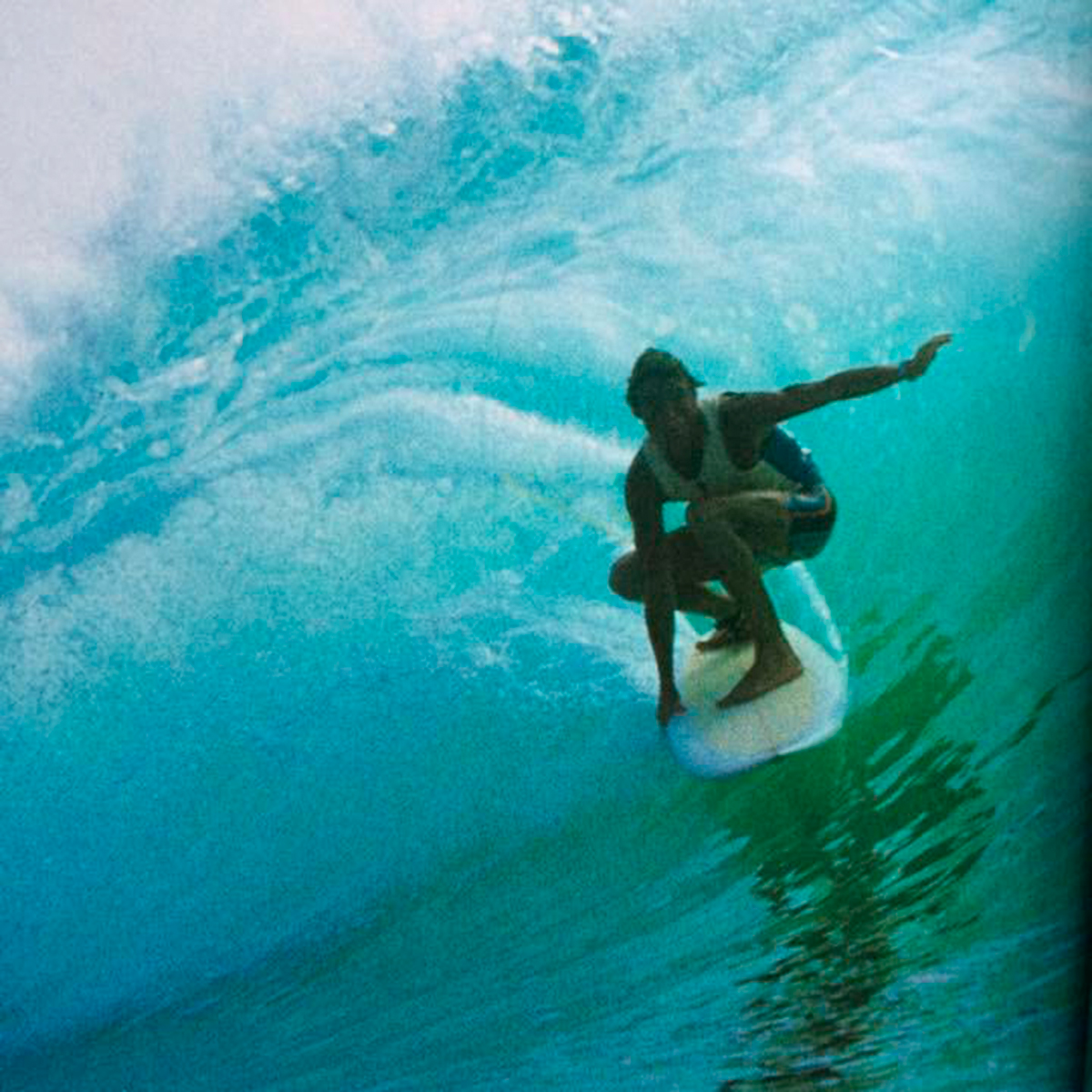
Ted at Padang Padang Photo: Hoole/McCoy
Ted believed. He had faith. Excalibur was real. And if it wasn’t, well, then he would make it real. He would take a myth and insert it into everyday life and thereby transform the world. He would, in a way, become Arthur. Or at least Merlin. Perhaps he was indeed, if Arthur had any substance to him, through the ancient Coventry family, a descendant of Arthur. He surely had a drop of Arthurian blood running through his veins. Maybe every true born Englishman did. In the absence of a handy stone that he could miraculously draw the sword out of, Ted talked Paul Holmes, an expatriate Brit who was then editor of Surfer, into funding a real sword, to be forged by the jeweller Mitch Nugent in England. A blade made of steel and a hilt cast in bronze and silver and encrusted with sea creatures set against some trop- ical backdrop. “A treasure any king would be proud to wield,” Ted announced to the world. Engraved with the words, “The Spirit of Surfing”, it was to be awarded to the winner of the Excalibur Cup, a charitable surfing competition dreamed up by Ted. “According to legend,” he recalled, “Excalibur could not be defeated in battle, as long as the user would only fight for right and justice, a noble concept.” Only Queen Guinevere was missing – but surely, reasoned Ted in his mystic logic, once Excalibur existed then Guinevere could not be far behind. As it once had been, so it must be again: the present moment appeared as only a temporary falling away from perfection, a transient and intermediate state that could not endure.
The idea first came to Ted in Australia, he said, when he was having a game of tennis with Rabbit Bartholomew. Singles. Man-on-man. In a classic lightbulb moment, Ted realised that the very same man-on-man concept could be applied to surfing. Eureka! A very fine idea. So fine, in fact, that it had already been espoused by the ASP, the Association of Surfing Professionals. The Excalibur Cup would therefore, in effect, be a rival to the ASP tour, the grand prix circuit. And, to some extent, an antithesis, almost an antagonist. It was Excalibur vs the ASP. Because the ASP was, as its name implies, “professional” and surfers expected or at least hoped that they could earn a living – or at least pay their expenses and keep the wolf from the door – by surfing under its auspices and participating in its contests. Whereas Excalibur was all about charity. As Paul Holmes, then editor of Surfer magazine, put it, “Ted was going in the opposite direction”. As was his wont. Nobody would win any money, nobody would be paid a penny, all proceeds would go directly to good causes, entirely omitting the shrewd and well-paid middle man. Excalibur was a vision of how the world might be. The ASP was simply an extension of the way the world is. Surfing as myth and legend – or surfing as a form of materialism, a career, in which you could work your way up the greasy pole. Ted tried to belong to both worlds, but his heart was really in Excalibur, the chivalric code. Chivalry was not yet extinct. “To gain, one has to be willing to give.” Such was the founding principle of Excalibur. The idea was to encourage or enable underprivileged or disabled kids to get to the beach and enjoy the “spirit of surfing”. A non-profit foundation was formed, its mission “to promote the sport of surfing, teach its participants the chivalrous concept of doing for others, and to raise funds for less fortunate individuals so they may enjoy their lives.” At first, Ted’s idea took off. He found established surfers willing to give of their time and energy and prowess in a quest for virtue and altruism. It was true Round Table stuff. These were one-day events involving the top eight surfers in the world. They pulled in the crowds and they raised thou- sands of dollars for youngsters. The inaugural event in 1982 at Burleigh Heads took place amid six-foot barrels and was won by Hawaii’s Michael Ho, beating Australian Cheyne Horan in the final. Perhaps the result could even heal the wounds inflicted by the Bustin’ Down the Door war and thus usher in everlasting peace. Ted recruited Australians who were towering figures in the sport such as Derek Hynd and Mark Richards to do the live commentary. Not to mention Australian “Playmate of the Year”, Lyn Barron. When Ted moved back to America in 1986 he took the Excalibur Cup with him. The “Excalibur Cup Foundation” was formed, “an independent non-profit corporation”. He had a vision of “getting the attention of all America” and raising at least $50,000 for good causes (“Special Populations”, “Monmouth County Seals”). Events took place, with reasonable success in Florida (three-foot barrels and offshore winds) and further north in New Jersey. “Much like in the legend of old,” Ted wrote when 15-year-old Kelly Slater – the future many-times-over world champion – took the title, “the youngest proved the most worthy.” They picked up celebrity support from actress and old flame Heather Thomas (by then the star of a TV show, Fall Guy) and Jack Sonni, guitarist with Dire Straits, who was a recent convert and enthusiast. Ted even invited the Prince and Princess of Wales (ie Charles and Di) to hand over the prize (a very pleasant letter from the Palace in response regretfully declined).
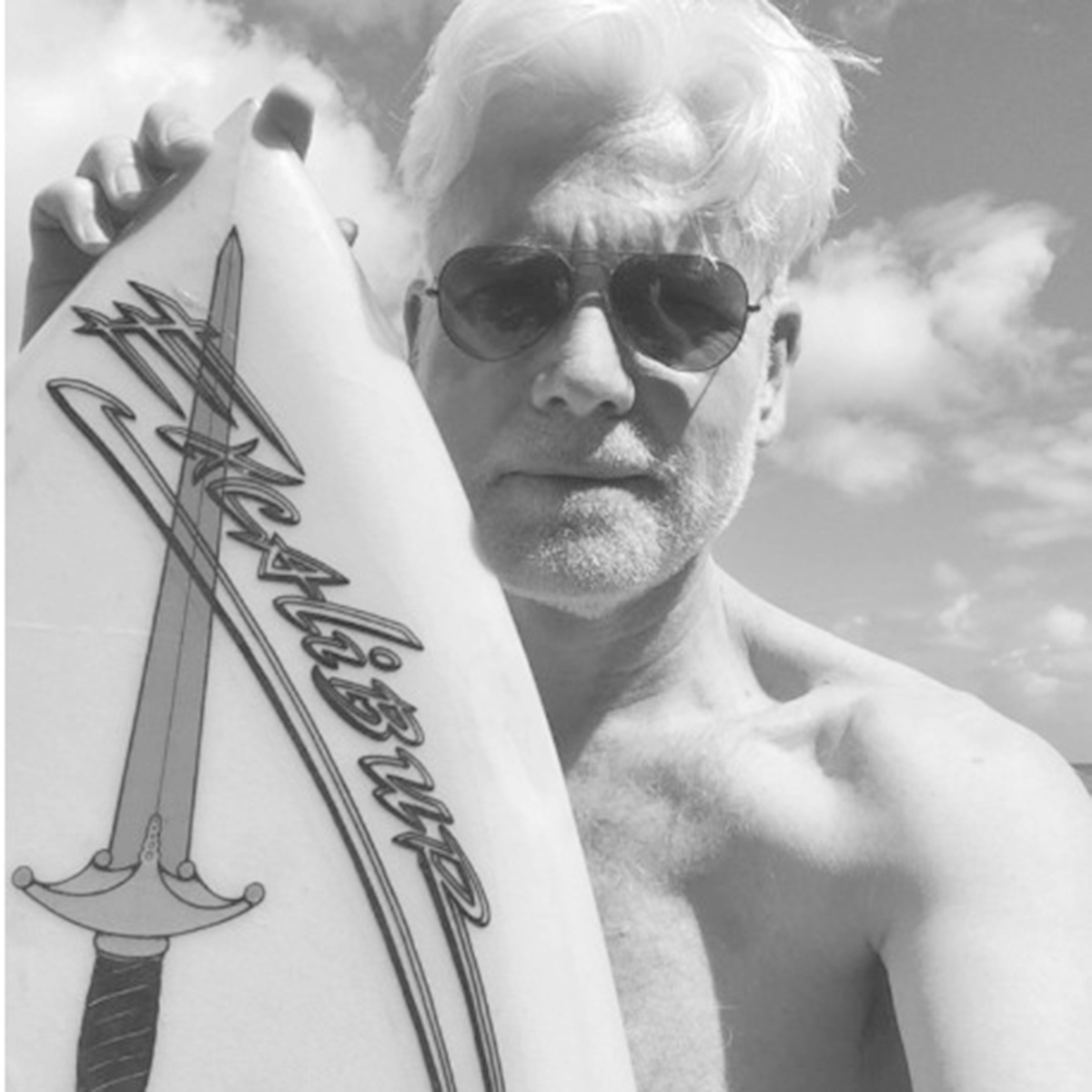
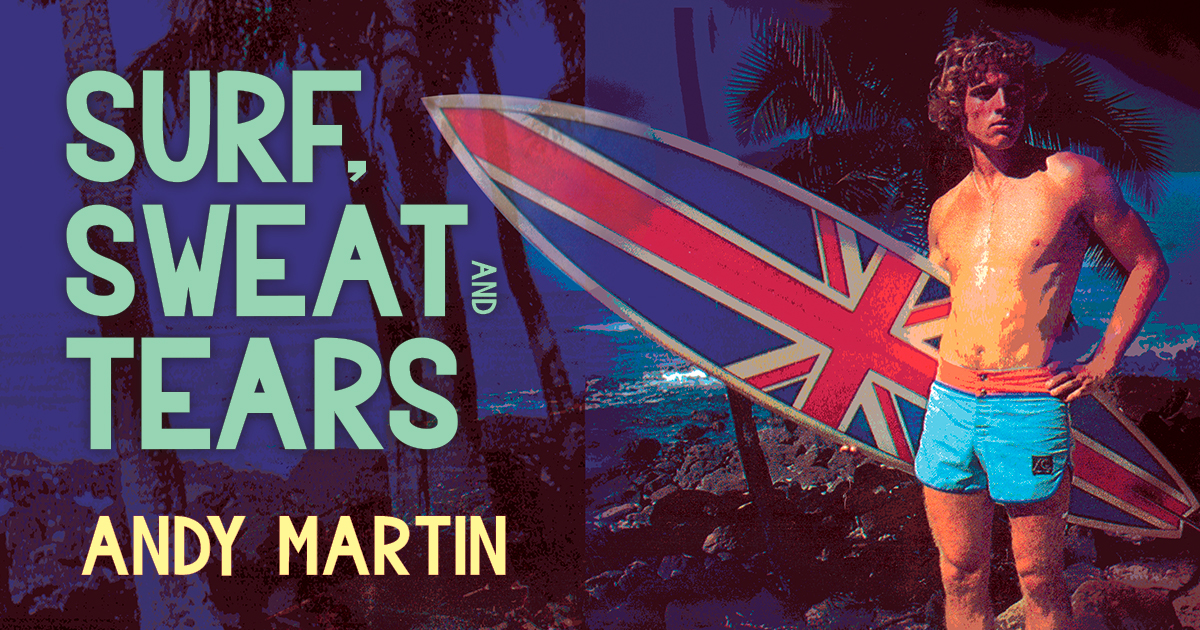
Above Author Andy Martin. Photo: Courtesy OR Books
However, putting on surfing contests, as Ted discovered, also requires the cooperation of Nature. After one particularly flat, cold, surf-free day in New Jersey (previously described in Ted’s hopeful notes as “a natural amphitheater” and a “consistent beach break” a mere hour and a twenty minutes train ride out of New York), Ted took the whole event off to the West Coast. Ted wrote, in his Excalibur notebook, that “surfIng has always had difficulty attracting the attention of the general media in America and it was hoped that by including celebrities more interest could be generated and greater amounts raised for our worthy causes.” To some extent, this theory seemed to be borne out in practice. “Heather Thomas was his Guinevere,” said Paul Holmes. Surfer paid for a whole page in Ted’s program wishing Excalibur CONGRATULATIONS. Ted wrote, “The long lines of fans waiting for Heather’s autograph in the cold weather of N.J’s spring proved this [the celebrity theory] true in 1987”. Surely on the West Coast this would be truer than ever, what with the proximity of Hollywood and Baywatch. Ted had visions of movie hunks and romantic interests desert- ing the set and taking to the waves in their droves. It would be a win-win. They had more to give and therefore more to gain. It was, to Ted’s way of thinking, only logical. But it turned out to be a Faustian pact. Excalibur became dependent on the whim of celebrities. Would they give a thumbs up or down? At the same time, surfing itself was becoming more than ever professional. And, reluctant though Ted was to admit it, something of the elusive “spirit” was being hoovered right out of it. Sponsors were energetically sought, and there was talk of Disney, and Universal Studios, among others, pitching in, but hard cash remained elusive. No Disney but only ‘FIJIAN TANNING PRODUCTS” and “Steve’s Breakfast and Lunch”. At the bottom of the cover of the Excalibur Cup program, 1988, there is a forlorn note: “A Contribution of any amount is appreciated to underwrite the cost of printing”. Fast-forward to Hawaii, 1991. We are sitting on the beach at Pipeline, Ted and I, waiting for his heat. The waves are perfect, in a way, vertical and tubular, but also precarious and terrifying. They rear up like immense steely blue cylinders, almost industrial, rolling off the assembly line of the reef, then smashing down and pulverising anyone unwise enough to get in the way. As Pottz once said, there is enough skin on that reef to stick a couple of humans together. Ted is fully focused, replaying some tank battle from the Second World War. Alamein perhaps. The sand is the desert. He actually has some toy tanks and soldiers scattered around. He is pointing out that if only Rommel and his Africa Corps had done this or possibly that, then he would have broken through Montgomery’s lines and made it all the way through to the Nile, thus decisively affecting the course of the war.
“How did the Excalibur go?” I say. The last time I had seen him he was brimming with enthusiasm about the new Excalibur contest. “Chivalry is not dead,” he had written. The rise of the ASP (he was, after all, about to paddle out in an ASP sanctioned event at Pipeline, sponsored by Quiksilver) was an issue, but it was not insuperable. Ted had taken the view that if you can’t beat them, you join them, you hitch a ride on the back of the ASP. So rather than set himself up as Rommel to the ASP’s Montgomery he had wisely compromised and located the next Excalibur Cup in Santa Cruz, California, the day after the ASP contest that was taking place right there, a mile or two away. Ted had even set up an office in Santa Cruz to oversee the whole event. It was a good plan: all the top surfers – Slater, Pottz and the rest – would fight it out on some classic Santa Cruz waves, they would earn their crust, they would get the accolades from the magazines, and then they would wander a mile or two along the beach and do their good deed, and dedicate a day – only a day! surely they could spare a single day? – to the young ones, poor, underprivileged, some of them disabled, who looked up to and idolised them. The program struck an optimistic note: “SOME OF THE WORLD’S MOST FORTUNATE PROFESSIONALS ARE PROUD TO BE GIVEN THE OPPORTUNITY TO HELP OTHERS”. They would be role models to these kids. Inspirational. Sporting heroes who showed that they had a spark of decency and kindness and caritas. Now abideth faith, hope, and charity, but the greatest of these is charity. “The waves were great!” Ted says. “Blue skies and off-shore winds the whole day.” “So the pros turned up then?” I ask, pleasantly surprised. Not sceptical but relieved and reassured about mankind. I had previously dared to express doubts regarding the likelihood of pros exerting themselves for a week at Santa Cruz and then merrily trooping off to volunteer for a day. I would have to take that cynical thought back. Ted drops a tank down in the middle of a whole bunch of toy soldiers. They are duly annihilated. They cease to exist. “Bastards!” A definite tinge of bitterness. “How many?” say I. “Not one,” says he. “Lots of local surfers. They were brilliant. But not one of these pampered, narcissistic super-stars could be bothered to haul their arses up the beach for the sake of the kids.” I put an arm around his shoulder. Even if he does have a tank in his hand. “Look, man, I guess it was always going to be a big ask to get them to turn up after Santa Cruz. Maybe you could try it before next time? That could work.” “Next time!” He adds something like “ha!” and kneels down and starts gathering together all the tanks and the soldiers and putting them back in his bag. Then he stops and looks up at me, shielding his eyes from the sun with his hand. “Sometimes I am seriously disappointed by the attitude. What ever happened to the Spirit of Surfing?” “Every man for himself?” Ted gazes out mournfully at the break. Someone is doing something miraculous: pulling into the tube, disappearing behind the curtain, and then – seconds later – getting spat out at the other end, raising his arms over his head, Hallelujah. The quintessential move. “I used to think surfing was all about giving.” He remembers one of his own lines from a pamphlet he had put together about the Excalibur: “The satisfaction of helping others.” “Yeah,” I say, sympathetically. “Overcoming the ego. Being at one with the planet, right? Feeling the force.” “And now...” He doesn’t actually use the word “taking”, but he is clearly thinking it. Perhaps chivalry really is dead after all. Ted, visibly upset. He looks as if he is on the verge of bursting into tears. But then he stiffens his sinews and sticks out his chin and rests one hand on the board he has standing up vertically, neatly, like a soldier at attention, in the sand. Emblazoned with the sword of Excalibur. He is a knight in armour again, only without the armour. “There is a spirit of selfishness abroad,” says he. “We have to keep going and fight against it. For the sake of surfing.” Any reasonable person would have quit. Ted refused to quit. He was the exact opposite of a quitter. Or reasonable. The more he got knocked back the more he would persist. The worse it was the better. It was like a last-man stand. It was like he wanted to go out in a blaze of glory, dying in the desert sands. Ted reminded me of Gary Cooper, the Sheriff, in High Noon. All the townsfolk had deserted him. And the train was due in any moment. But he didn’t care. He had a duty to fulfil. He would face down the bad guys all on his own if he had to. And what if he were to be taken out? Then so be it. The more alone he was, the stronger he felt, the more empowered, a man with a gun in his hand. The competition klaxon sounded. Ted’s heat was on. He dumped his soldiers with me and grabbed his board and ran down the beach and launched himself into the everlasting maelstrom that is Pipeline and paddled out. In many ways Ted was ahead of his time. Teaching the blind and disabled to surf. Now every serious competition has a cancer program or a pink ribbon. As late as the summer of 1996, only a year or so before he died, Blackie Blacker reported seeing him in New York, living in the attic of someone’s house, surrounded by boxes of t-shirts, with a notion of getting a new sword engraved with the names of past winners, and all “fired up” about a new edition of the Excalibur Cup. And hoping to recruit Bruce Springsteen to the cause. “He was his old self,” Blackie said. Undaunted, unbowed, unrelenting.
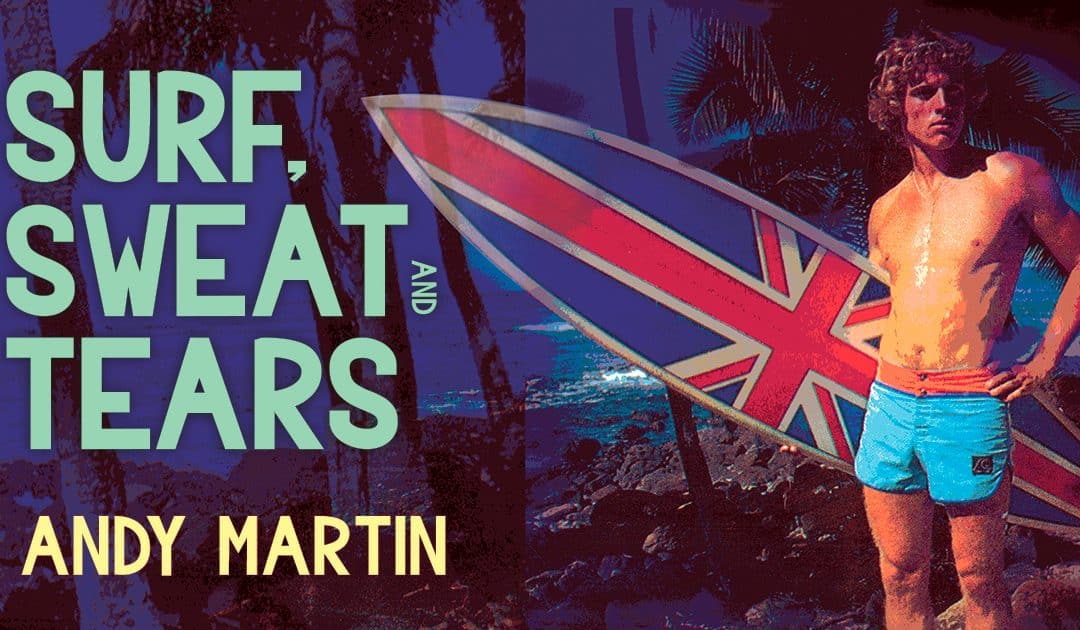
Surf, Sweat and Tears is available now from OR Books, New York. Click on the link below and enter the discount code CARVE15 to get 15% off the cover price of the print or e-book: