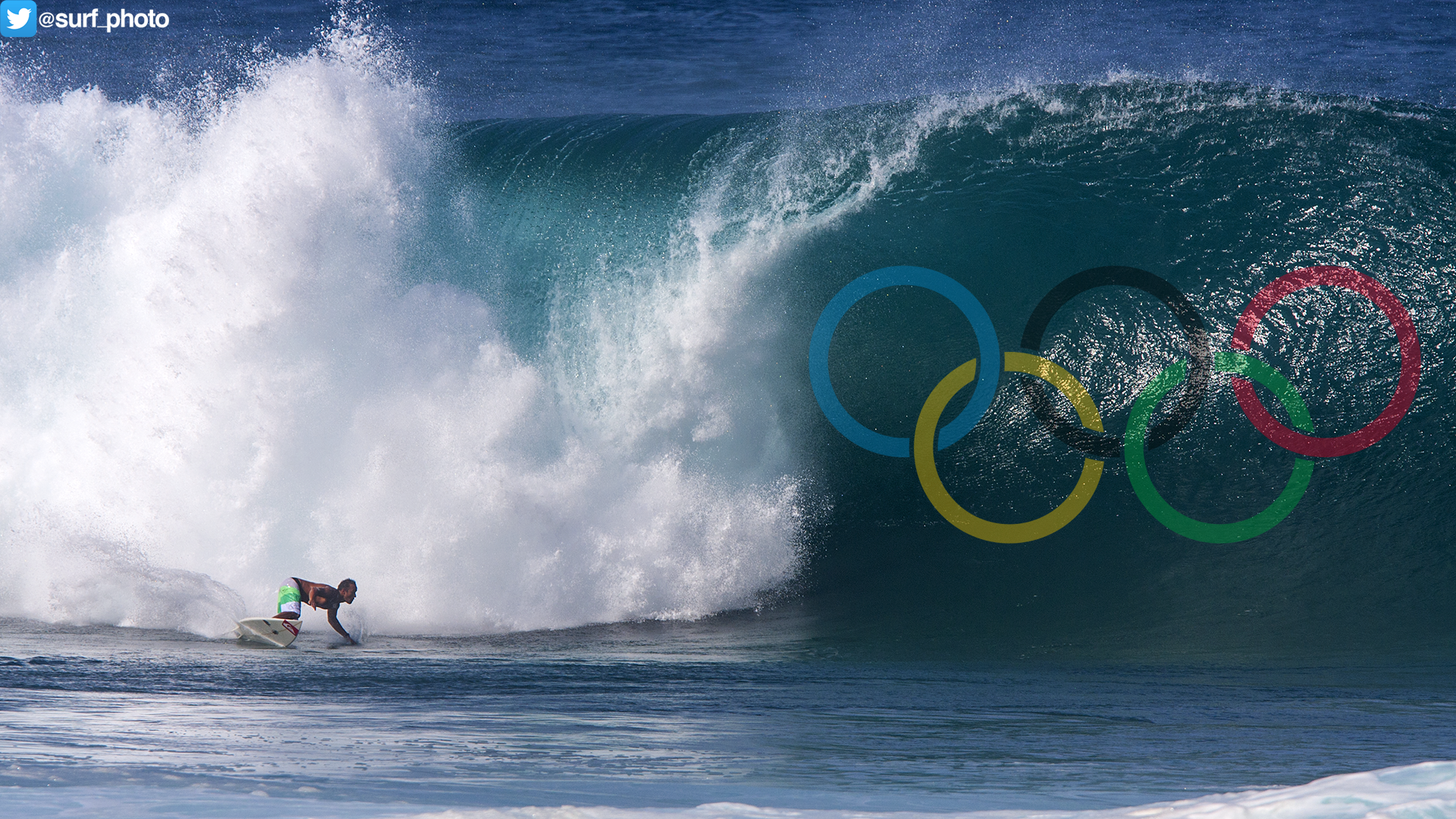
After years of campaigning by the ISA their long held dream of surfing in the Olympics has finally become reality…
From the IOC:
The International Olympic Committee (IOC) today agreed to add baseball/softball, karate, skateboard, sports climbing and surfing to the sports programme for the Olympic Games Tokyo 2020.
The decision by the 129th IOC session in Rio de Janeiro was the most comprehensive evolution of the Olympic programme in modern history. Plans call for staging the skateboarding and sports climbing events in temporary venues installed in urban settings, marking a historic step in bringing the games to young people and reflecting the trend of urbanisation of sport.
IOC president Thomas Bach said, “we want to take sport to the youth. with the many options that young people have, we cannot expect any more that they will come automatically to us. We have to go to them. Tokyo 2020’s balanced proposal fulfils all of the goals of the Olympic agenda 2020 recommendation that allowed it. Taken together, the five sports are an innovative combination of established and emerging, youth-focused events that are popular in Japan and will add to the legacy of the Tokyo games.”
The response from athletes seems positive, understandably as representing your country at the Olympics would be an amazing experience. The response from everyone else covers the full spectrum from stoked to oh god to don’t care.
The one plus side is it will be ocean based, not in a wave pool, assuming there’s some swell in the two week summer window of the event.
The thought process makes sense. Snowboarding injected much needed excitement, cool and ‘youth interest’ in to the Winter Olympics and the IOC is hoping the same for the summer version. Admittedly the snowboard fraternity haven’t been exactly stoked with the whole deal.
Formats and how who gets to go is decided is a long way down the track. It’s a good thing for the smaller nations. As while the surfing superpowers will be favourites this will be a platform for those countries with a few very talented surfers to make a dent. Expect some epic tales of surfers from landlocked nations enjoying their five minutes in the sun.
The other new sports make sense. Well. I’m amazed karate wasn’t already there? Baseball seems a tad odd as it’s not a particularly global sport. Sports climbing will be fascinating and the skating will be incredible as that’s far more easy to digest for armchair sports fans who will understand the dynamic from the snowboard halfpipe events.
As for surfing. I don’t see it working myself. If the public aren’t interested in the world’s best in the world’s best waves on the WSL why would they be interested in a few of the world’s best and a lot making up the numbers?
If you’ve ever tried explaining a surf contest to a non-surfing friend you’ll know what I mean. It’s impenetrable. It’s not neat like skating or snowboarding. The session atmosphere of riders going bigger than the last for ever more complex tricks is not surfing. A sport where you can get a ten-point ride for just standing up and trimming down the line … if you happen to be doing it in a barrel.
Whatever your opinion it’s happening. And the ISA’s hopes of millions of new surfers (eeek!) getting turned on to the glide draws nearer.
New for Fall 2016, Patagonia introduces the world’s first and only neoprene-free wetsuits made with natural rubber from sources that are Forest Stewardship Council® certified by the Rainforest Alliance. It’s a groundbreaking innovation that doubles down on the company’s initial entry into natural rubber in 2014 with another industry first, and expands Patagonia’s Yulex™ wetsuit offering from two to 21 full-length suits for men, women and kids.
The entire line of Patagonia’s all-new, high-performance wetsuits is made with natural rubber developed in partnership with Yulex and Forest Stewardship Council (FSC) certified by the Rainforest Alliance. The certification assures customers that the source plantation isn’t contributing to deforestation, and that it’s managed in a way that maintains the ecological functions and integrity of the forest. The Rainforest Alliance—an international nonprofit dedicated to the conservation of biodiversity and sustainable livelihoods, with a focus on tropical landscapes—performs audits to confirm that the plantation adheres to the FSC’s standards on the ground.
“Surfers and wetsuit manufacturers—including Patagonia—have relied on neoprene for years, despite the fact that it’s a nonrenewable, petroleum-based material with an energy-intensive manufacturing process,” says Hub Hubbard, Patagonia’s wetsuit development manager. “Neoprene is nasty stuff, but for a long time we had no alternative. Through our partnership with Yulex we’ve invested in a plant-based game-changer and built it into our entire fullsuit line.”
The neoprene-free Yulex wetsuits perform as well or better than conventional neoprene wetsuits. But because the main polymer is produced in trees instead of factories, using natural rubber reduces the CO2 emitted in wetsuit manufacturing by up to ~80 percent. The FSC certified rubber is blended with a small amount of chlorine-free synthetic rubber for increased ozone and UV resistance, and to meet Patagonia’s rigorous demands for durability and strength. The Yulex process also removes over 99% of impurities, resulting in a nonsensitizing material.
The new plant-based polymer pioneered by Yulex is sourced from Guatemala, where hevea trees are grown on reclaimed farmland. Hevea has long been the source for the most demanding rubber applications, including car and airplane tires. Some of the world’s supply, however, is grown in newly clearcut rainforest zones, making the rubber industry a major driver of deforestation in tropical countries. Patagonia avoided using hevea until a more sustainable source could be found.
As with their previous work, Patagonia and Yulex are again sharing this groundbreaking innovation with other companies, hoping to create a shift toward cleaner and less harmful materials throughout the surf industry. The release of the new line is the result of a decade of Patagonia’s work in developing alternatives to neoprene. Patagonia published a blog post about the environmental impacts of neoprene in 2008, the year the company started manufacturing wetsuits. The post is available here.
“Yulex could not have found a better partner than Patagonia to champion this breakthrough for the surf industry. The collaboration between our companies has been an example of how sustainable products can be brought to customers without sacrificing performance and cost competitiveness,” commented Jeff Martin, founder and CEO of Yulex Corporation. “Patagonia has an exemplary business model which Yulex and others continue to embrace.”
Patagonia’s Fall 2016 wetsuit line has new, fast-drying thermal linings and new floating front-zip entries as well as back-zip options. The new and exclusive inverted microgrid linings, made with the highest possible recycled polyester content, dry faster and create lighter suits while maintaining excellent warmth.The floating front-zip increases the wetsuit’s lifespan and features an asymmetrical flap for better stretch, seal and mobility. Featuring wetsuits rated for six different temperature levels, Patagonia’s collection has offerings that will keep surfers warm in water temperatures ranging from 23°C down to 0°C.
The new wetsuit line was released globally in Australia in March of 2016 with six fullsuit styles. All 21 fullsuit styles will be available starting August 1, 2016 in North America, and Japan. 20 fullsuit styles will be available in Europe. Prices for the Yulex natural rubber suits are comparable to conventional, high-performance wetsuits; the new season also marks the first time Patagonia has offered a wetsuit built specifically for kids.
Patagonia wetsuits are available for purchase at Patagonia San Sebastian Surf store, select surf shops and at Patagonia.com.
About Patagonia
Founded by Yvon Chouinard in 1973, Patagonia is an outdoor company based in Ventura, California. A certified B-Corporation, Patagonia’s mission is to build the best product, cause no unnecessary harm and use business to inspire and implement solutions to the environmental crisis. The company is recognized internationally for its commitment to authentic product quality and environmental activism, contributing over $70 million in grants and in-kind donations to date.
Peru, the South American country home to the beautiful Amazon rainforest and Machu Picchu (set high in the Andes Mountains), is also home to the 21-year old high-flying Peruvian surfer Miguel Tudela. Miguel has been making a name for himself by being the guy who can surf 2 foot mushy shorebreak just as good as 20 foot heavy Waimea. We’ve seen him charge Pipeline on the North Shore of Oahu in heavy conditions, and prove his shredability in smaller waves, but now Miguel is putting sheer focus and determination into his true passion: big wave surfing.
Mitch Crews and Evan Geiselman join forces with fellow Reef Ambassadors Kai Otton, Mick Fanning and Roby D’Amico hunting for those elusive sandbars in France.
Calling all surfers, bring your surf gear or boards to Boardmasters to swop or sell!
This year Boardmasters are stoked to be teaming up with Carve Mag to host their first ever Surf Swap Shop. This give anyone the chance to bring their surfboards, surf accessories and memorabilia to Fistral Beach to swap with fellow surfers or to simply pick up a bargain. Come and get involved, its all going down on Thursday at the Fistral Beach Bar from 10am. Plus the British Museum will be bringing along some of their finest vintage boards to look at. It’s going to be an interesting morning, see you there!