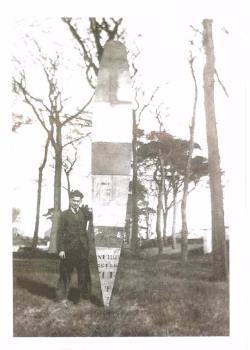
Joe and his board made from discard tea chests in 1949.
Joe Roddy, one of Ireland’s first surfers has passed away.
Former Tonnta editor Wayne Murphy takes up the story.
“It is sad reporting on the passing of people you have met who inspired many minds and gladdened more hearts. Kerry man Joe Roddy passed away today.
Joe was one of Ireland’s first real “watermen” and he lived a long and great life. I interviewed Joe many years ago while gallivanting around Kerry one summer with my Donegal friend Francis McGloin. We were heading out by small boat to spend a day on the old monk’s hermitage at Skellig Michael. Before that journey we had seen this old black and white picture of Joe, circa 1949, of him proudly standing next to a 16ft paddle board. We would later find out that Joe made it himself from old wooden tea chests. I was immediately intrigued with that photo. Francis and I tracked Joe down. It wasn’t too hard – it was his son who was captain of the boat taking us to the Skellig. So we met Joe in a Kerry pub for a chat. Charming and gracious as ever, he kindly told us a few fascinating parts of his life story. Here it is:
Most students of commonly accepted Irish surfing folklore believe the art of riding waves in Hibernia began in the early 1960s when Kevin Cavey first experimented with plywood boards in the Irish Sea at Bray in county Wicklow. Perhaps the opening chapter in the book on Ireland’s surfing history actually goes back a couple of decades further than most readers would be aware. Picture this, the summer of 1949, a quiet stretch of beach near Dundalk in county Louth. Weekend strollers, many still dressed in their Sunday best, walk along the seashore. A few braver ones wade and splash about in knee-deep water. The general mood of these seasonal beach-goers matches the lazy sound of the gentle waves spilling and rolling towards the shore. But not everyone in the vicinity shares the same balmy, end-of-summer malaise. About a mile out to sea, unbeknown to the people frolicking on the beach, a strong dexterous teenager is paddling hard toward shore on a craft never seen before in Irish waters.
Joe Roddy, the son of an Irish lighthouse keeper, has just launched his latest home-made contraption, a 16 foot paddle-board made mostly from discarded tea chests and lashings of sturdy lighthouse paint. Joe got the design from a woodworker’s manual but, with materials required to build such a craft in short supply after World War II, was forced to improvise. Having to make do with very little was a simple fact of life for young Joe who would soon become renowned for his beachside acrobatic skills and spear fishing talent. Blessed with strong maritime leanings, but living on an island inhabited largely by a population with an inherent fear of the sea, it is easy to understand how many folk back then were quick to label Joe as being a bit peculiar, eccentric even. After all, this was the same man whose curiosity for what lived under the sea drove to him to develop his own set of primitive scuba diving equipment. Flippers? No bother for Joe, just cut off some metal down-pipe and flatten it out into triangular shapes before attaching them onto an old pair of boots. Face mask? Easy, a few minor adjustments to an old military gas mask. As for a wetsuit, Joe simply painted a few coats of tar onto some Long John underwear.
Such dedication would see him eventually go on to represent Ireland at the World Scuba Championships at Cuba in 1967, complete with his own set of home-made spear guns, of course. Joe even met Fidel Castro there after breaking a free dive record. But it wasn’t what was underwater that had captured Joe’s full attention on this particular summer’s day in 1949. Rather, it was the delightful feel of his wooden craft as it picked up speed with an incoming wave. A few more paddles saw Joe instinctively scramble to his feet. Then, standing erect in the same antediluvian fashion and manner as proud Hawaiians did for centuries before him, he rode tall and confident along the shore-bound breaker while carefully aiming his half-submerged tea-chest craft towards the unsuspecting group of bathers and strollers on the beach.
Imagine. Suddenly there is a bit of commotion on the shore. A surprised murmur quickly turns to gasps of shock and awe as more heads turn and look out to sea at the dark mysterious Christ-like apparition standing on water fast approaching them. Joe was greeted by stunned silence from the astonished crowd. He fondly recalls seeing nothing but “the whites of their eyes and their gobs smacked wide open,” as he stepped onto the beach and into the history books to arguably become Ireland’s first surfer.
70 years and millions of waves have passed since Joe Roddy’s seminal ride. When I interviewed Joe he was about 80 years but still going strong. He was learning Samba dance lessons and really enjoying his time with many of the enthusiastic younger ladies. The sparkle in his eyes were a joy to behold as he told us this and more. While Joe’s epic ride pre-dates Kevin Cavey’s experiments in the surf by more than a decade, it remains entirely possible there are others, be they locals or visitors from overseas, who may well have ridden waves somewhere along the Irish coastline before these two pioneering Irishmen. And that’s not including all the fishermen, warriors, priests, poets and such like who have ridden waves in traditional small craft and then recounted orally or written in verse about the thrill of their close encounter with tonnta na hEireann (Irish waves).
RIP Joe Roddy. Go raibh mile maith agat.

Thousands of surfers paddled out to protest Norwegian oil drilling company Equinors proposed exploration in the Australian southern ocean Bite.
After a huge social media campaign surfers and beach lovers from right around Australia united to send out a huge message. To date 15 Australian councils, and over 500,000 pope have expressed concerns and opposition to the project.
For a 30-day period from February 19th to March 20th 2019, Equinor’s draft Environment Plan (EP) will be open for public comment. You can place pressure on the company by submitting your comments at: link
But not only this, speak out on social media by using the handle @equinor and commenting on their post – shame them on what they are doing publicly. Keep up the fight until they back out of drilling in the Bight.
Full story below
Bight Back

Bight Back
by Joshua Burguete-Kirkman
We are all David, when it comes to this Goliath. The fight against Equinor to save the Great Australian Bight needs your voice now.
“Is it acceptable to experiment with new technologies in waters deeper, rougher and more remote than ever before, in an area that already sustains the largest fishery in the southern hemisphere, and has many thriving coastal communities?”
Anna and Tim, comfortable in their psychedelic garden in South Australia pose this question to Dave Rastovich. Rasta is on the ground with locals, helping build a movement to fight back against the proposed exploration and extraction of oil in the Great Australian Bight by Norwegian (majority state-owned) company Equinor. He’s also documenting this growing resistance to ‘Big Oil’ for the Patagonia film Nevertown (released last year) which touches on a number of environmental challenges faced by local people in Australia. Big Oil is a big one.

The South Australian coastline is rugged, unforgiving and beautiful. On land it is hot and dry. Kangaroos and emus will run past you on the roads. In the water it is cold and full of life in abundance (harmless and not so harmless). The surf can be exceptional (but you didn’t read it here) with long stretches of coastline providing myriad opportunities for exploration and solitude. But this isolation provides equal doses of risk and reward – you could get some of the best waves of your life, but if you get into trouble in the water in South Australia you might not live to tell the tall tale at the pub later a few hundred kilometers away…
The South Australian horizon reaches south towards the cold Antarctic polar region. A region that is also unforgiving yet beautiful. Cold winds and storms brew in the south and often hurl themselves at the rugged coastline. Huge waves characterize the oceanic vista more often than not. The brutality of these swells is famous. This is the type of harsh, challenging environment South Australians have learned to live with and grow from. It’s not always pleasant, but to them it is normal. To visitors it is equal parts fear-inducing and awe-inspiring.
This special part of Australia is under threat
A new fear-inducing entity has crashed into the coast of South Australia recently. This one has travelled from another cold place that is equally beautiful and unforgiving, Norway. An old business (Statoil) with a new name (Equinor) is proposing to explore the waters in the Great Australian Bight for oil and this poses a very real threat to everything locals and visitors hold dear.
In 2017 Equinor became the operator and 100% owner of exploration permits which cover approximately 12,000 square kilometers in the Great Southern Ocean. This is water in the Great Australian Bight. If Equinor is given permission to proceed the damage to the local ecosystem will begin and the risks of future oil spills will increase. This should concern you. It concerns those who live along that stretch of great southern coastline, that’s for sure.
This concern and fear has not led to apathy or resignation, as South Australians from all walks of life (and soon a global movement, with your help) are coming together to fight back. On a local level, people are coming together to try and stop this madness from materializing. Those on the ground in South Australia are hoping that a shared appreciation for natural spaces and a shared concern for pollution and global warming will galvanize support for their cause in the place that Equinor calls home – Norway.
“Australians are certainly distrustful of the double standards Equinor are showing here, and I feel that Norwegians would feel the same. The wider Australian public share the same view as Norwegians on climate responsibilities.”
“In Norway, seismic testing of this type has been put on hold near the Lofoten Islands for exactly the same reasons… namely the damage to phytoplankton that prop up the entire ecosystem, not to mention the effects on whales, seals, dolphins and fish not on the seafood menu.”
That’s right, the methods used for testing for oil reserves are also on the nose in Norway. The fight in Lofoten isn’t over though, and the fight for the bight is heating up right now in Australia.
Who the hell is Equinor anyway?!
Equinor (formerly known as Statoil) is one of the world’s largest offshore oil companies. They operate in 30 countries worldwide and they employ 20,000 people. They are the largest operator in Norway, with the people of Norway owning about 70% of it (it is majority government owned). Their total revenues for 2017 were 61 Billion USD and almost all of this revenue came from oil, one way or another.
Anyway, this story is about drilling for oil in really dumb places and what can be done to stop it. For the people in the Great Australian Bight, this really is a ‘David and Goliath’ battle.
Not dissimilar to the people confronting Big Oil in Australia right now, a small but passionate group of people and organizations managed to stop the oil and gas industry from drilling near the Lofoten Islands, Norway only recently.
Seismic testing to explore the possibilities of oil outside Lofoten, Vestreålen, and Senja was proposed but showed a risk of disrupting the path of the cod that swims down from the Barents Sea once a year (a fish that has fuelled that region’s prosperity for centuries). Troubled locals banded together and took action as a collective and the area is now protected.
A small, dedicated group of people in Lofoten were ultimately successful against the odds, but can it happen again now? Against a giant like Equinor?
Dave Rastovich has been on the frontlines with the communities rising up against Equinor in Australia and he is encouraged by what he sees:
“In Australia right now, you have each local council, representing the southern and SW/SE communities of Australia, rallying to formally oppose big oil. These small communities are going to local governments, who are then going to state government and then nationwide. Local media is reacting, nationwide media is reacting and look at us now, talking to someone from near the Arctic Circle!”
“In this particular issue and campaign there are small things happening at a grassroots level – surfers talking to local fishers, who are talking to the local whale watching industry – all communicating on a nice grassroots local level but turning that into bigger momentum and bigger action – and making formal opposition to any threat that comes to the area. I think it’s neat to see that level of action.”
People from all walks of life, industries and political backgrounds are coming together to say to Equinor that they want to enjoy their oceans their way without risk of devastating pollution. This movement, which started small and local, is quickly spreading across communities, countries and cultures and there is something every one of us can do about it.
It’s time to bight back.
What to do now?
First and foremost, we urge everyone to speak up today to say “No.” to Equinor. “We do not agree – enough is enough.”
For a 30-day period from February 19th to March 20th 2019, Equinor’s draft Environment Plan (EP) will be open for public comment. You can place pressure on the company by submitting your comments at: link
But not only this, speak out on social media by using the handle @equinor and commenting on their post – shame them on what they are doing publicly. Keep up the fight until they back out of drilling in the Bight.
You may have seen many top pros getting involved through their social media, so why not get involved yourself?