Rip Curl And WSL Announce Three-Year Renewal Of The Rip Curl Pro Bells Beach And Portugal

Rip Curl And WSL Announce Three-Year Renewal Of The Rip Curl Pro Bells Beach And Portugal

Rip Curl and the World Surf League (WSL) are pleased to announce the three-year renewal of two major events on the WSL Championship Tour (CT) calendar, the Rip Curl Pro Bells Beach and the Meo Rip Curl Pro Portugal. With this renewal Portugal welcomes back the world’s best female surfers, the first time the women’s field has had the opportunity to compete at Supertubos since 2010.

"Rip Curl is celebrating 50 years of surfing this year and Championship Tour events have always been a part of what we do. We love the sound of the heat hooter in the morning,” says Neil Ridgway, Rip Curl’s Chief Brand and Marketing Officer.

2019 will mark the 58th year of the Rip Curl Pro Bells Beach, and the 11th edition of the Meo Rip Curl Pro Portugal. This three-year renewal will see Bells through to its 60th year, a mammoth landmark for competitive surfing.

“Both of these events are combined, supporting men and women equally in both hemispheres of the world,” continues Neil. “You can't have one without the other – gender or hemisphere ¬– if you mean it. We were born at Bells, so our place there goes without saying; and we have been in Peniche 30 years too and our love for the town and the event gets bigger every year. In Europe, you need a World Title event to say 'Ultimate Surfing Company' – and there's no better way to stamp our brand's place on the Continent than at the Rip Curl Meo Pro Portugal."

“Bells Beach and Peniche are both incredibly important stops on the Championship Tour and, with the 2019 season set to be the biggest yet, we are thrilled to be extending our partnership with Rip Curl to support these events through 2021,” said WSL CEO Sophie Goldschmidt.

“Australia’s Bells Beach is one of the most iconic stops on the tour and a real barometer for surfing excellence. Portugal is a true highlight of the season and plays a crucial role in deciding our men’s world champion each year. This year we are very excited to see our female surfers compete alongside the men in Peniche and look forward to watching them push performance levels.”

Jose Farinha, the General Manager of Rip Curl Portugal, has seen how a CT event has grown surfing in and around his region. “Since we first started holding an event in Portugal back in 2009, we’ve seen a huge increase in surfing and surf tourism in the country – and with this, positive socioeconomic effects.

“For Rip Curl, Portugal has been an important part of the history of our company in Europe. We couldn’t be more excited to extend this relationship once again.”

The Rip Curl Pro Bells Beach will run from April 17 until April 27 and the Meo Rip Curl Pro Portugal holds a waiting period from October 16 through 28.

#BornAtBells

Photos courtesy WSL / Ed Sloane

Carve’s comprehensive guide to foil boarding. How to start, etiquette, gear and more

Carve’s comprehensive guide to foil boarding. How to start, etiquette, gear and more

We have all seen those videos: Kai Lenny doing endless loops pumping around small wave breaks and riding for miles on open endless ocean swells. And we've heard the claims; “It's like flying!” But what is going with foil boarding? And could they be the perfect alternative for tiny shitty waves?  We asked two top foil companies and two surfers who have taken up the foil and fallen in love with them, Stokesy and Cotty, to find out.

ALAN STOKES

What drew you to foil surfing?
I love surfing and snowboarding as soon as I saw Kai Lenny surfing open ocean swells on a foil I thought it looked like snowboarding on water.

What are the advantages of having a foil?
It opens up so many places you couldn't or wouldn't even think of surfing before.

What is the best thing about it?
It feels like surfing, snowboarding and flying so when you do a carve it's just an insane feeling!

How do you start? What equipment do you need? Do you have to buy a board and a foil? Are there any specifics you need to be aware of - board sizes/foil sizes?
You need to be able to surf quite well to surf foil. Starting is hard, and you need to start in small forgiving waves with a helmet on. It’s a steep learning curve so take your time and be safe. You will need a foil board similar size to your regular surfboard or smaller. I love the F One 5'0” Rocket surf foil board. Plus a large foil wing like the F One Gravity 1200.

How do you get going on one? Is it something you can learn on a lake or do you go straight the sea? I see some people use jet skis to get started?
It's easier to learn the basics towed behind a boat to understand how the foil lifts and turns and then progress to surf.

Do start on paddle board foil board or a sup foil board?
If you surf, I think it’s easier to start on a surf foil board.

What are the best conditions for foiling?
To learn small crumbling swell in deep water.

What are your top tips for safety?
Go to beaches that are not crowded, wear a helmet and always move away from other surfers.

When you see people pumping around lakes or breaks … is that as easy as it looks?
Haha, no, trust me I've tried, but it's fun when you get it right.

ANDREW COTTON

What drew you to foil surfing?
I originally was thinking of how to surf bigger waves so decided to learn the basics.

What are the advantages of having a foil?
Anything becomes surfable! I went from thinking about riding the biggest waves to the smallest. You end up looking at the ocean and the energy it has in a completely different way.

What is the best thing about it?
You feel like you’re flying. It’s hard to describe, but it’s addictive.

How do you start? What equipment do you need? Do you have to buy a board and a foil? Are there any specifics you need to be aware of - board sizes/foil sizes?
I went straight to the experts and asked for help, like learning anything new it’s essential that you're on the right equipment and I had a clear progression planned. I was lucky, as I learnt behind the ski then took it to paddle in, as it’s harder learning just paddling in.

How do you get going on one? Is it something you can learn on a lake or do you go straight the sea? I see some people use jet skis to get started?
I went from behind the ski learning the very basics, then to towing into waves and progressing into paddling prone into foiling waves.

What are the best conditions for foiling?
Half a foot backing off unsurfable waves, basically you're looking for the worst wave possible!

What are your top tips for safety?
Don’t try and correct yourself, if you think your falling, then fall! You don’t want to land on the foil. It hurts

What kind of waves/beaches are best for learning to foil? Did you start in smaller waves and work up?
It’s all about small waves, or surging water. Tap into the energy that before wasn’t rideable

When you see people pumping around lakes or breaks … is that as easy as it looks?
I wish it were! It’s so hard it’s unbelievable, but regardless it’s a lot of fun, and once you try it I guarantee you’ll be addicted.

Foiling Etiquette

There is a lot of talk about foils and the danger they pose both to their users and other water users. But as with all watercraft if used correctly and etiquette and safety are observed there should not be any problems. Here are few tips from the pros:

  • Stay away from all other people in the water when learning to foil. You have a three-foot blade on the bottom of your craft. If you are not a pro, you are a danger in crowded conditions.
  • Foils are better in swells rather than waves anyway.
  • Always wear a leash, this protects others around you. Longboarders without leashes cause enough problems. Imagine a stray foil water.
  • Wear a helmet and impact vest when first learning. Foiling is tough and has a long learning curve, and you will fall off, you will have to dodge your own foil. Be safe, not sorry.
  • Do not take off with someone directly in front of you.
  • When other surfers are present, go somewhere else and ride that part of the wave the surfers cannot ride or do not want to ride. This is the beauty of foiling.
  • Heavier metal foils are more dangerous, so choose wisely as their momentum keeps them going after a fall and can hurt you or others around you.
  • Make sure you pick the right board and foil for surfing.
  • Be aware of submerged rocks and sandbanks
  • Do not foil alone.
  • All foilers should police other foilers who are being dangerous and educate them. If you see someone not sticking to the rules, point it out to them.
  • Stay away from crowded surfing lineups.

everything you need to know to start foiling

How foils work and how to learn…
Just think of the foil as an underwater aeroplane. Point the plane up, it goes up, point the nose down, and it will go down! The key is maintaining speed and proper altitude. Get to the proper speed then “level off!”

What speed does the board need to get to before the foil lifts the board?
For average weight riders, the board and foil need to reach speeds of around 4­-8 mph. Heavy riders will need to get more speed, and conversely lighter riders will need less. Riding regular surf (waves on the shoreline) will be easier to attain a foiling position as the wave is helping you.

Can I ride a foil if I have no experience?
Yes! For the first time foilers using a boat or jetski to pull you through the water at very slow speeds is the easiest way to learn. This will enable you to get the “feel of foiling”. Weight back on the board will lift foil up, and weight forward will bring the nose back down. Holding weight forward after “Lift Off” is the correct position or train of thought to maintain a proper foil glide.

If you don't have access to skis or boats then when you're in chest-deep water, start paddling out as you do on a regular board.

You can ride everything. Even the worst wave you've ever seen in your entire life. So the best way to get started is to find a spot with small waves in the one-to-two-foot range. The goal is to paddle into whitewater and, when you stand up, you'll have all the power you need to ride the hydrofoil.

When you spot a wave coming, start paddling until you feel you've caught it. The take-off process on a foil board is identical to that of surfing. As soon as you stand up, apply pressure on your front foot, like if you were snowboarding on the slopes. The steeper the wave gets, the more you need to lean forward.

On your first rides, you'll experience a different feel compared to regular surfing. You'll need to adopt a squat stance while keeping your chest vertical and your shoulders wide open so that you maintain the right balance and you don't fall.

The more you lean back on your back foot, the more the wing is going to tilt upright, creating more lift. In the opposite direction, the more apply weight on your front foot, the more the wing will dive underwater.

What type of waves should I learn on?
First and foremost, waves where other surfers are not. The last thing you want to do is put someone else in danger with your foil. To start small crumbly waves are the best. The goal is to catch the whitewater, get enough speed to pop up, then slowly increase back-foot pressure to get on-foil.

What kind of foil do I need?
For paddle-in surfing, you’ll want a foil with a relatively large front wing and plenty of early lift so you can get up and foiling easily on small waves. Slingshot’s Hover Glide FSurf foil comes stock with our Infinity 76 surf wing, which is perfect for all-around paddle-in surf foiling. The F-One Gravity 1400 wing is ideal to learn how to surf foil even in the smallest waves.

Can I use a surfboard I already own?
It depends. You’ll need a board with a dedicated foil box installed. Local shapers are tuning in to foiling, and many are starting to install track boxes for their customers, either in custom boards or existing boards with enough volume to be retrofitted with a box. If you look at a dedicated surf foil boards featured you'll notice a few distinct design details that make a big difference. High volume and a thick, blocky tail are a big help in early takeoff and small, mushy waves.

What length mast is best for learning? (the mast is the length of the metal between the board and the foil.)
Start with a short mast. Shorter masts are easier to control, safer to learn with and will make a big difference in how fast you progress past the eating shit phase. For tow-in foiling or larger waves, a longer mast will allow for more speed and more vertical range.

How dangerous it?
Foils are sharp, and there’s no getting around it. They need to be, for efficiency and performance. So yes, there’s a level of risk that comes with it, especially when you add waves to the equation. If you take precautions (like wearing a full wetsuit, boots, a helmet and an impact vest or PFD) the risks are minimised, and once you get over the learning curve, they drop dramatically. Starting with a short mast in small, crumbly surf will make a big difference in keeping things safe and under control.

the equipment

Foil Board: High Roller
A new generation of foil surfboard designed specifically for paddle-in foil surfing, carving and pumping until your legs catch on fire. Unlike any surfboard you’ve ever ridden, the High Roller is packed with foil-specific features designed for easy paddling, early takeoff, cat-like agility and Superman pumpability.

Buoyant enough to paddle into tiny waves and compact enough to remain agile and playful once you are foiling, High volume "S-Rail" paddles like a board twice its length. The concave deck gives heel-toe leverage for responsive turning and carving. Compact, easy to travel with and transport.

RRP:
£1100 to £1200

FSurf Foil
Easy to catch waves and once you are up it rides waves effortlessly without the need for excessive “monkey pumping”. Unless of course, you want to pump, then go for it on the way out. There are plenty of foils out there with tons of lift, but they tend to be super slow and can’t keep up with most waves without pumping to generate speed. Faster foils, meanwhile, need more speed to get going and don’t work for the small, rolling waves foilers love so much. The FSurf package, equipped with our new INFINITY 76 wing, is the best of both worlds. A large outline provides all the low-end lift and pump-ability you’ll ever need, while its unique inverted gull wing shape allows for much faster top-end speeds than foils with similar surface area.

Features:

New Infinity 76 wing - tons of lift, tons of range. New carbon composite construction - more range and more efficient. Modular Hover Glide system. Shift fuse allows different connection for different performance. 61 cm (24”) Aluminum mast - sturdy, super durable, ideal size for surfing. Safe-T winglets prevent injury

RRP:
£1050

Foil Board: ROCKET Surfboard

Created exclusively for foil surfing, the F-ONE Rocket Surf line gather all the shape features that will help to get the most out of the foil.

Easy take-off and maximum freedom in flight, once in the air, shorter board length translates directly into more freedom and possibilities.

Enough volume is required to ensure the boards are accessible and facilitate the take-off. The Rockets, therefore, pack as much volume as decently possible into minimum board length. The result is a range of compact boards dispatched as follow: 4’2 (26.5l.) – 5’0 (35.5l.) – 5’8 (41l.) – 6’4 (52l.)

There is a size for everyone and every level from the pocket-size 4’2 intended for experts to foil with maximum freedom, to the 6’4 that boasts volume and width suitable for learning.

Parallel rails and flatter rocker line in the centre of the board make up for an easy and early take off. A distinctive kick in the rocker towards the tail helps with release and pumping. The outline is kept wide on the nose to keep these short boards user-friendly.

All boards are fitted with a both a US track system and a tuttle box to accommodate any foil with a tuttle head or a 4-bolt top plate.

They are built with a light and tough bamboo sandwich laminate around a lightweight EPS core, thereby achieving a great resistance to weight ratio. The boards come with a tail pad, while a front pad is included as an accessory which can be fitted on or not depending on personal preferences.

RRP: £705 -£750

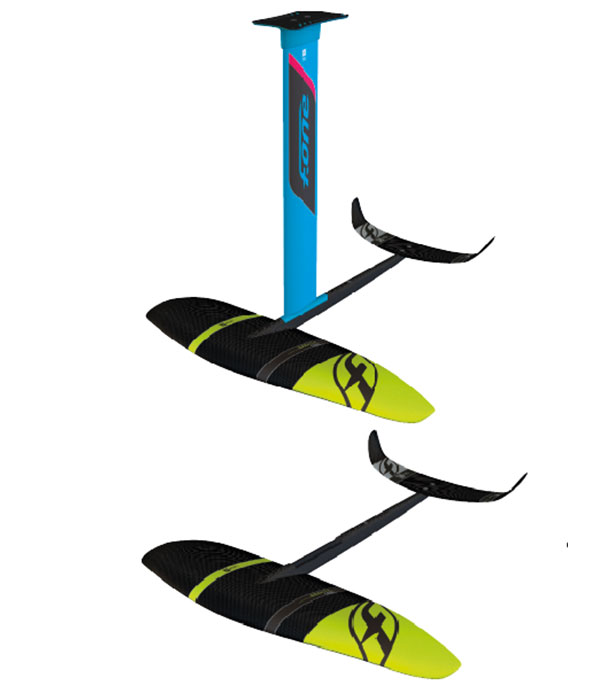
Hydrofoil: GRAVITY 1400
The F-ONE GRAVITY 1400 wing is ideal to learn how to surf foil, enjoy the smallest waves and also venture on a downwinder.

It has a low-speed take-off and is very stable with superior glide and a new and thicker section profile for an early and very progressive lift-off evolution of the arch and rake of the wing to best combine manoeuvrability and control

The design targets ease of use to surf and carve lines with an early lift for take-off, easy entry into the turns for some intuitive lines, manoeuvrability allowing sharp turns. Very fluid through the turns, allowing to draw tight or long curves with good speed control and good pumping to go after the next wave.

Targeted at people who want a wing to foil on a variety of waves from small and mellow to taller and faster.

Area: 1480 cm3

Aspect Ratio: 4.3


RRP:
£940

Become a Surf Instructor in 2019

Become a Surf Instructor in 2019

Become a Surf Instructor in 2019

Being a surf instructor is up there with one of the best jobs you can have as a surfer. Commit to a course and get qualified and in no time you will be rewarded with a job where you get to spend every day on the beach, work in surf camps across the globe and you get to see the faces of super stoked pupils daily. 
 
We asked the people in the know what’s involved in becoming a surf instructor and take a look at courses on offer. 

Q & A

Surf South West

What are the basic surf requirements for becoming a surf instructor?
All level 1 surf instructors need to be able to demonstrate that they can paddle out back by duck diving or using a ‘turtle roll’. Maintain position in the line-up and take off on the peak on unbroken waves. They need to be able to pop up efficiently and be able to trim left and right along the wave, ending their rides with control. They need to be able to show understanding of basic surfing etiquette at all times.

What is the difference between level 1 and level 2?
The level 1 qualification focusses on all the skills required to take complete beginner surfers to the stage where they are starting to take off on unbroken waves for the first time. This is the entry level qualification and all you need to start teaching in the UK. The level 2 qualification is aimed at elite and club level coaches. It covers video analysis, fitness, and long term athlete development.

Are your qualifications internationally recognised?
The ISA (international surfing association) are the recognised governing body for surfing around the world. Their qualifications are internationally recognised.

Surf Coach Academy

What standard of fitness do you need?
You need to be able to swim at least 200 meters and meet the requirements for the surfing assessment.

What standard of surfing do you need to have?
For level 1 a candidate should be able to paddle and negotiate their way out back in surf approx. 1m surf. They need to demonstrate good ocean awareness, wave selection and positioning in the line up particularly relating to maintaining theirs and others safety. Clear demonstration of surfing etiquette, ie not dropping in. When riding waves the skill level required is to be able to take off on an unbroken wave, do a bottom turn, traverse across the wave, demonstrating good trim and as a minimum basic turns up and down on the wave ie roller coastering. The surfer must be able to end their ride with clear control with a kick out the back off the wave or controlled stall. This ability needs to be shown on a consistent basis. The surfer must show they can ride both backhand and forehand. The surfer must be able to return back to shore safely.

Is there a minimum or maximum age limit?
Minimum age is 16 years. No max age. At 16 you can sit the course but will be classed as an Assistant Coach until turning 18. Until a coach turns 18 they are not able to work alone and must work under the supervision of a coach who is over 18.

Stoked Surf Adventures

What qualifications do you need to become a surf instructor?
To be a surf instructor you need an internationally recognised certifications (ISA and ASI are two of the most common options) and also a surf lifesaver certificate. Level 1 of both are the standard for beginner surf coaching and enough to get you started on your surf career.

How long does it take to qualify?
It really depends on your surf skills. The surf competence test involves catching green waves both left and right, paddling out back safely and also controlled dismounts, so that the minimum aim. If your skills are already at that level you can smash out both courses combine in around 7 days. There are some epic "zero to hero" style courses (we offer them in South Africa, Australia, Morocco and Bali) that can get you to that level in 10-12 weeks with barely any previous surf experience. If you're not quite there there are also options for 4 and 8 weeks too (such as the Bali options we offer)

Do you need lifeguard or first aid training?
You don't need a full beach lifeguard certification to surf coach but you will need a surf lifesaver certificate. This covers the basics of in water rescue (including paddle boards and spinal drills) as well as CPR and first aid modules. Don't worry though these certifications don't require any previous knowledge.

ASI

What are the benefits to the job?
When you become an ASI surfing instructor, you are part of the worldwide network...ASI surfing instructors are professionals, just like accountants or lawyers. As such ASI surfing instructors are trained to the highest standards in the world, with the ability to connect to other members and schools worldwide. You can become an ASI trainer and train other instructors and be sent to locations anywhere in the world.

What are the negatives to the job?
Not many. You can follow the sun, and the seasons. You meet a whole lot of people in countries where you don’t know anyone or anything. Its fun. However, if you are doing too many lessons you can get burnt out. So remember to pace yourself and enjoy !

What are the stages to becoming a surf instructor?
With ASI, you need to know how to surf at least at the intermediate level. You wont believe there are others offering qualifications where you only have to be a basic surfer! ASI has created the worldwide criteria for intermediate surfing level (and beginner and advanced) so you know exactly where you stand or surf. As a professional, you are trained to the highest standards. Attend training workshops, complete practical hours and keep your skills updated by working on the job. See the ASi website for specific details on what is required at each of the surfing instructor levels.

SURF INSTRUCTOR COURSES

Stoked Surf Adventures

Want to plan your perfect surf trip? Whether it’s jumping on an epic surf adventure, training to be a surf instructor or finding the perfect surf camp Stoked Surf Adventures has you covered! With destinations from the Maldives to Bali and South Africa we’ve got something for everyone. We also have the largest range of instructor courses on the internet!

Australia: Year round, £4780
South Africa: Jan and Sept, from £5295
Morocco: Jan and Sept, from £4275
Bali: March, June, Sept & Dec each year, from £2054
Sri Lanka: April and Nov, from £895
UK: April through to Oct, from £300

stokedsurfadventures.com 
[email protected]

Surf Coach Academy

Surf Coach Academy is a professional qualification service provider. We offer ISA (International Surfing Association) surf coaching level 1 and 2 accreditations. These awards are internationally recognised and set the benchmark for surf coaching qualifications worldwide . If you would like a job on the beach then we can get you qualified to set you on your career pathway.

Location: Newquay, Cornwall, England. Fistral beach and Towan beach
Price: £300 level 1, £400 level 2

Dates: 30-31 March, 27-28 April, 18-19 May, 15-16 June, 29-30 June, 14-15 September, 12-13 October, 9-10 November

www.surfcoachacademy.com
[email protected]

Surf South West

The level 1 surf coach course gives new coaches the skills to take beginner surfers into the ocean. This covers surfer safety, venue analysis, specific coaching techniques, communication skills, group management and lesson planning. The course takes place both in the classroom, on the beach and in the ocean, where participants demonstrate their own surfing ability and practice putting their coaching skills into action under our guidance.

Location: Croyde, Devon
Price: £299

Dates: 30-31 March, 20-21 April, 11-12 May, 8-9 June, 6-7 July, 14-15 September

www.surfsouthwest.com
[email protected]

ASI - Academy of Surfing Instructors

The ASI is the world’s leading professional membership, education and accreditation body for surfing, SUP and bodyboarding. Operating in over 20 countries, instructor careers range from Level 1-Level 5 Master Coach with continuing professional development. ASI accredited instructors attain skills and competencies to work in any location throughout the world.

Dates & Locations:
UK: Jan - Nov (L1, L2, L3) - Dunbar Scotland, Pembrokeshire Wales, Challaborough Devon, Bude Cornwall, Gwithian Cornwall.
Australia: Jan - Dec (Apprenticeship, L1, L2, L3) - Noosa Heads Queensland, Scarborough WA, Arrawarra NSW, Ulladulla NSW, Palm Beach Queensland, North Wollongong NSW.
USA: Jan - October in USA (L1, L2) - Hanalei Bay Hawaii, Montauk Long Island.
Portugal: March to Dec (L1, L2, L3) Sagres

Prices: From £240 – £260

www.academyofsurfing.com
[email protected]

King Of The Point Goes off on UK’s East Coast

King Of The Point Goes off on UK’s East Coast

For the second year running the Secret Spot KING OF THE POINT supported by Rip Curl went down in stellar conditions. After waiting through several ‘amber warning’ swells the signal finally went green late afternoon Saturday. The invited list of surfers scrambled logistics and assembled at dawn on a frosty spring morning. The plan for the day was to run round 1 at an out of the way left hand cobblestone reef. A quick turnaround and blast to a pounding left hand ledge for round 2.

A highlight of the East Coast surf comp scene that involved many of the old legends and an increasing number of younger frothers from the main regions os Scarborough, Whitby, Saltburn, Tynemouth and further afield. After the final horn was blown it was straight to the nearest pub for presentation.

“This was such a great event to be involved with for Rip Curl. A real core event that helps promote the scene in this proud surfing region.” Joel Gray Rip Curl UK

“The original idea was born to bring a group of surfers together from different locations. Rather than have a knock out contest format we wanted to keep people surfing all day. Two rounds with plenty of time in the water with people enjoying the camaraderie of it all.” Scotty, Secret Spot.

“Stoked to pull off another great contest in great waves.” Tomo, Secret Spot.

In the end to cheers from everyone the winner was Saltburn goofy footer Kris Fairest.”I missed the event last year so I was stoked to be able to do it this year. Im really pleased to win and Ive had a great fun day – a good laugh with everyone together. Big thanks to Tomo and Scotty for putting the event on. Everyone had a laugh and hope it’s on next year.”

Results

Kris Fairest 1st Place
Gabe Davies 2nd Place
Joel Gray / Evan Rogers 3rd place
Sandy Kerr 4th place

Best Wave
Joel Gray

Longest Wave
Posh Tom (Tom Wilson)

Raddest Drop
Delboy (Broadbent)

Queen of the Point
Emily Grimes

Grom of the Event
Cade Dickinson

Best Wipeout
Andy Hogg
Prawn (Shaun Thomas)

WSL rejigs the format

WSL rejigs the format

The WSL is gearing up for the big league season start in April with the welcome confirmation that they’ve tidied up the way comps work, as detailed above and below. No more long painful Rd2 or random Rd5. This also means if conditions are pumping overlapping heats can be run, maximising waves on offer and shortening event windows.

Championship Tour Format Updates
The WSL CT is the world’s premier surfing series that crowns the undisputed women’s and men’s World Champions at the conclusion of each season. With the goal to improve the competition for both the athletes and the fans, new format updates will be introduced this year.

“As we continue to evolve and improve all areas of the sport, we have made important format updates to the Championship Tour,” said Sophie Goldschmidt, WSL CEO. “Our goal is to further raise performance levels with a surfer-first mentality, while also engaging the fans. We hope that going straight to head-to-head matchups from Round 3 onwards will drive more direct competition while making the format more engaging for viewers.”

The new updates are a continuation from last year’s format changes, which eliminated Round 5 in the men’s event and Round 4 in the women’s event. There will now be linear advancement (bracket) after Round 3 to the Finals, in addition to head-to-head matchups from Round 3 to the Finals. Additionally, all head-to-head heats have the option to ‘overlap’, which means two heats can run simultaneously, giving the events more flexibility to run during the best conditions.

Men’s CT Format Updates

  • Round 1 will still have twelve heats with three surfers in each heat. Athletes who place first or second in Round 1 heats will both directly advance to Round 3, which will differ from the previous format where only first place advanced to Round 3.
  • Round 2 will now have four heats with three surfers in each heat, as opposed to the previous format of 12 heats with two surfers in each heat. Of the three competitors in each heat, the lowest-placing surfer in the heat will be eliminated in Equal 33rd place.
  • Round 3 will now have 16 heats with two surfers in each heat, as opposed to the previous format of 12 heats with two surfers in each heat. The lower placing surfer will be eliminated in Equal 17th place.
  • Round 4 will now have eight heats with two surfers in each heat. The lower placing surfer will be eliminated in Equal 9th place.

Women’s CT Format Updates

  • Round 1 will still have six heats with three surfers in each heat. Athletes who place first or second in Round 1 heats will both directly advance to Round 3, which will differ from the previous format where only first place advanced to Round 3.
  • Round 2 will now have two heats with three surfers in each heat, as opposed to the previous format of six heats with two surfers in each heat. Of the three competitors in each heat, the lowest-placing surfer in the heat will be eliminated in Equal 17th place.
  • Round 3 will now have eight heats with two surfers in each heat, as opposed to the previous format of four heats with three surfers in each heat. The lower placing surfer will be eliminated in Equal 9th place.

Also Olympic stuff:

The 2019 WSL CT is the top of the hierarchy in the Olympic qualification system for the world’s best surfers. The world rankings at the end of the 2019 CT season will determine 18 of the 40 places at the Olympic Games Tokyo 2020 (10 men and 8 women). The remaining 22 places will be determined at the 2019 and 2020 ISA World Surfing Games, the 2019 Pan American Games in Lima, and a single slot (each for men and women) for the host nation, Japan (if they have not already qualified through the mentioned routes).

The 18 places that are allocated at the WSL CT come with a condition that a country cannot qualify more than two athletes per gender. This means that if Australia qualifies three athletes, only two can go to the Games and the other place is allocated to the next highest ranked.

Following the final CT events of the season (the Hawaiian Pro and Billabong Pipe Masters), the world rankings will determine the first highest 18 eligible qualifiers for the Olympic Games Tokyo 2020, subject to all qualified surfers meeting the ISA’s and IOC’s eligibility requirements and being selected by their respective National Olympic Committee.

And equal pay stuff:

Last September, the WSL announced equal prize money across all owned and operated events, becoming the first US-based global sports league to do so. It’s an initiative that has been a long-term goal for the organization and one that has come to life after new ownership took over the organization in 2013. Equal prize money was instituted for the 2018/2019 Jaws Challenge, which ran in November 2018, and for the first stop of the revamped Longboard Tour, the Noosa Longboard Open, which ran earlier this month.

Now, the Boost Mobile Pro will host the first CT event to award equal prize money. There will be equal prize money for every women’s CT stop this season and beyond. The opening CT stop in April will also launch a global beachside engagement program for girls, Rising Tides – WSL Girls Program,  which will offer clinics at each women’s CT stop in an effort to inspire the next generation to take to the surf.

2019 will also see the continuation of the Pioneers program, which celebrates female legends, as well as the launch of an international marketing campaign to highlight the women’s tour and increase event viewership and fan engagement as well as a number of other activations that will be announced in the coming months.

The Quiksilver Pro and Boost Mobile Pro Gold Coast will open the season on April 3 and run through April 13, 2019. The events will be broadcast LIVE on WorldSurfLeague.com and Facebook.com/WSL. Also check local listings for coverage from the WSL’s broadcast partners.

For more information, please visit WorldSurfLeague.com.