
When it comes to fins the classic lines: “Ahh, how am I going to notice?” Or “They can’t make that much of a difference to me.” These trains of thought seem to be rapidly dying out these days. And for good reason.
Fins make a massive difference. They can make or break the feel and performance of a board. And if you have your fins dialled in, it will certainly help to improve your overall surfing experience.
BUT with some many options available you have to have strategy for finding your perfect fin.
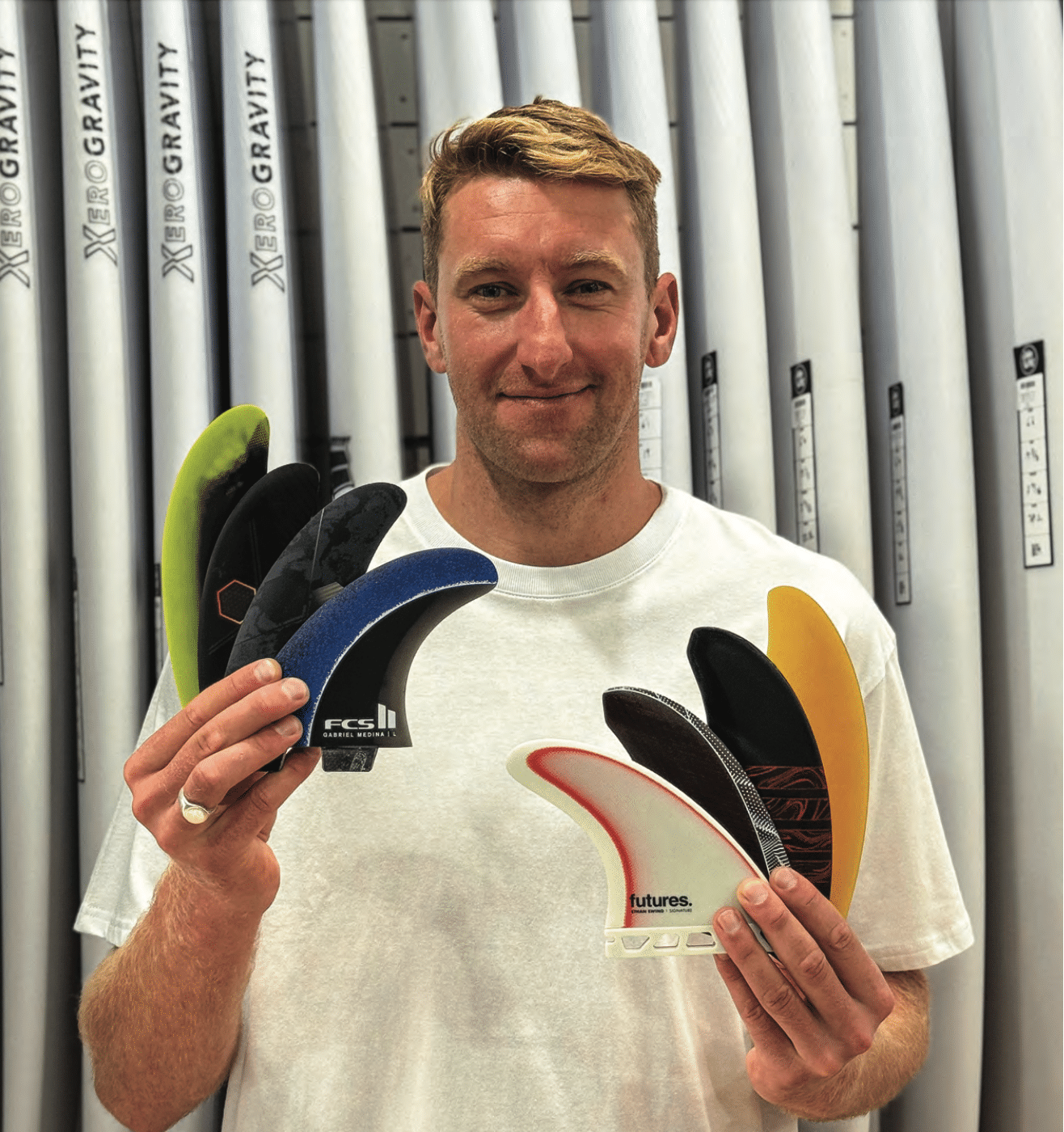
Down the Lines Justin Lapskas has helped thousands of surfers with board and fin combos so we asked him for his top five tips when choosing a new set of fins:
1. Find out what you like from a fin
How you surf can have a huge impact on what you are going to want from your fins. For example, a fin with more rake will give you more hold, and is better suited to drawn out carving tuns. Whereas a more upright template will give you more pivot and will be better suited to snappy turns in the pocket. So knowing what you like, and what you want from your fins, can enable you to dial in your equipment.
For instance, our good friend and local ripper Tyson Greenaway surprised us recently when choosing fins for his JS Black Baron. He deviated from the recommended upright twin, in favour of a keel fin. This isn’t the recommended combo, but Tys is an exceptionally powerful, and exceptionally good surfer, and he knows that he likes more fin area and more drive, so they work well for him. Which shows that you can fine tune your fin choices to suit your individual requirements.
2. Experiment
It’s always useful to try different fins. For example, Reubyn Ash was in the shop a few weeks back telling us how he loves to use MRs in his Monsta 10. We’d never usually suggest a twin plus trailer in a shortboard like this, but he reckons it flies in smaller surf with the MRs. This is something that we are seeing more and more – experimentation with twin trailers, thrusters with large sides and small centres, twin plus twos… the possibilities are endless.
Try something different and it might just surprise you. Worst case scenario, it doesn’t go quite to plan, or will confirm what you knew already. The common retort to this is, “but I don’t have endless sets of fins,” or, “I don’t have friends with other sets of fins”. But worry no more… because we have an extensive range of demo fins. Drop into the shop and take a set for a spin free of charge anytime.
3. Construction is key
Certain styles of surfing and types of surf require different levels of flex from a fin. For example, if you’re a heavier, more powerful surfer, or are surfing in powerful, heavy waves, then you may want a stiffer fin to harness that power. PC Carbon, Techflex and fibre glass constructions will offer
a stiffer flex and more control. Whereas in everyday conditions, a fin
that offers a more optimised flex – such as PC, Blackstix or Honeycomb construction–would be advantageous in order to provide more flex and more response through your turns.
Getting a feel for flex and what you are going to require from your fins in certain conditions can be really useful. It can allow you to dial in your favourite board and enable it to perform at the highest level in a wider range of conditions.
4. Size Matters
There are all sorts of weight-to-fin size recommendations out there, however we are noticing a trend of more and more people deviating from this.
Generally, it seems that there is one very important rule to bear in mind: bigger fin = more lift. This means that it can be hugely advantageous to use bigger fins in smaller surf, as they should give you more lift and more drive. Whereas in bigger waves – and certainly when you are surfing a step-up with a narrower tail / more refined rail – you should benefit from smaller fins, to harness this design and add more bite and control.
Check out the video on YouTube of JJF and John Pyzel discussing this. It proves to be incredibly insightful and makes total sense.
5. Listen to the shaper
If in doubt, look to what the shaper recommends. Certain fins just seem to work well some boards. For instance, the AM template is one of the most popular fins across FCS and Futures, and we see people loving them in a range of different boards.
However, certain boards are designed for specific fins, so it’s always worth paying attention to this. For example, if you look at the template of the
CI Fishbeard, you could easily think it would suit an upright MR style fin. But Britt pushed the fin boxes forward in order to accommodate a keel fin. Similarly, Jim Banks tells us to never put uprights in his Revolution design – it’s got to be a keel fin, or ideally, the Hooker fins. So, there can certainly be elements of board design that will have a huge impact on what fins bring the best out of the board. Shapers know best. So take their advice as a starting block. then you can impart your own individual preferences and look to experiment from there.
Overall, when it comes to fin choice, it’s important to remember that as with all aspects surfing, that there are literally no rules! So, try something out of the ordinary and you might just discover something amazing.
Experiment with different fins in different boards, and over time you will discover what you like and be able to hone your equipment choices. We are blessed these days with a sheer abundance of information, available at the click of a button. So, do your research. Check out what your favourite pro surfers ride, listen to what the shaper recommends, and then use this to steer your own fin choices in the right direction.
Most importantly though, go surfing and have fun with it.
Check out the latest from FCS, Futures and Koalition fins here