Nurdles on the Tyne

Nurdles on the Tyne

A few days ago, I got a phone call from Joel Gray, an ex-pat Geordie now living in the South West and currently Carve Editor-at-Large

I think the opening exchange of our conversation pretty much sums it all up.

“San, I’ve seen some pictures. What’s the craic with these nurdles?”
“It is so much worse than any picture can show,” I replied.

How it started.

On 19 July, two vessels collided on the River Tyne. Wind Orca, a wind turbine installation vessel, collided with the berthed container ship BG Orange, rupturing containers and the hull of the vessel.

Among the damaged containers was one carrying approximately 25 tonnes — around 1.5 billion — plastic nurdles. And suddenly, they were spilling into the River Tyne.

So, what exactly is a nurdle?

A nurdle is a tiny plastic pellet. It is essentially the raw material used to make plastic products. Melted down, these little pellets can be turned into almost anything, from water bottles to furniture.

The fall out.

So now we had billions of them in the Tyne.

The Tyne is tidal, with water constantly moving in and out every minute of every day. The nurdles began to spread quickly, with huge quantities becoming trapped in inlets, around obstacles and along the river’s edges. Then they made their way out into the North Sea.

Within hours, they were being spotted on our beaches.

Before long, millions of these tiny plastic pellets were scattered across our beautiful coastline.

As I write this, nurdles are being found as far north as Cresswell Beach, around 20 miles from the mouth of the Tyne.

The full extent of the fallout is still unknown, but the environmental impact could be devastating. You can already see seabirds pecking through seaweed and along beaches covered in nurdles. I can only imagine the impact this will have on marine life and fish.

There is also the obvious danger that these tiny pellets look like food. To a bird or fish, they could easily be mistaken for something edible.

The blame game

This has been a rapidly evolving incident, and there have been what appear to be huge failings at almost every level.

There has been a failure to recognise the scale of the damage quickly enough, and a painfully slow response to cleaning it up by councils and contractors working on the Tyne despite the fact that every passing tide was spreading the nurdles further.

The Council were still using a beach rake used for picking up large bits of beach rubbish but it was effectively ploughing the beach, l pushing plastic deeper into the sand rather than removing it.

Volunteers were also initially being told not to touch the nurdles because they could be dangerous.

So many questions have been raised about the response from the councils, environmental agencies and the Port of Tyne. What is being done? Why has the response been so slow? And what is being done to contain the spill and respond at the scale required?

Like most of the responses we’ve received, we often feel fobbed off. But we keep following up, we do our due diligence, and we keep pushing on.

And, of course, there is the fundamental question of responsibility: who is ultimately accountable for the initial release, and why wasn’t a large-scale industrial clean-up operation put in place immediately?

The good

When this first happened, nobody really knew how to begin cleaning millions of tiny plastic pellets from our coastline.

But people got out there.

They started experimenting, sharing ideas and figuring out which tools worked best. Once the jungle drums started beating, the response from our community was absolutely incredible.

The brilliant people at the charity Nurdle have been there with machines to speed up the operation and hundreds and hundreds of people have come together, working around the tides and physically picking up these tiny pellets with nets, dustpans, brushes and sieves.

I honestly couldn’t be prouder of the community we live in.

To see so many people care so deeply about our local environment — and then actually get out there and do something about it — has been incredibly inspiring.

This is our coastline. These are our beaches. And people have shown that they are willing to fight for them.

What now?

The job is by no means finished.

And it is becoming increasingly clear that we cannot rely solely on the public sector or the institutions involved to clean this up. The scale of the problem is simply too big.

If you’re local, you can get involved in one of the many community clean-ups taking place across the area. Check the website and local WhatsApp groups to find out where and how you can help. At the moment, many of the clean-ups are being organised around the tides.

You can also sign the petition calling for the UK to mandate zero plastic pellet loss and help keep this issue firmly on the national agenda.

Write to your MP. Write to your councillor. Write to the Mayor.

We are all knackered from this but please.

Keep asking questions.

Keep talking about it.

Keep showing up.

All the information you need, including details of clean-ups, petitions and templates for contacting your representatives, can be found below.

Arran Strong – Gone too soon.

Arran Strong – Gone too soon.

Words: Joel Gray Photo: GB Surfing

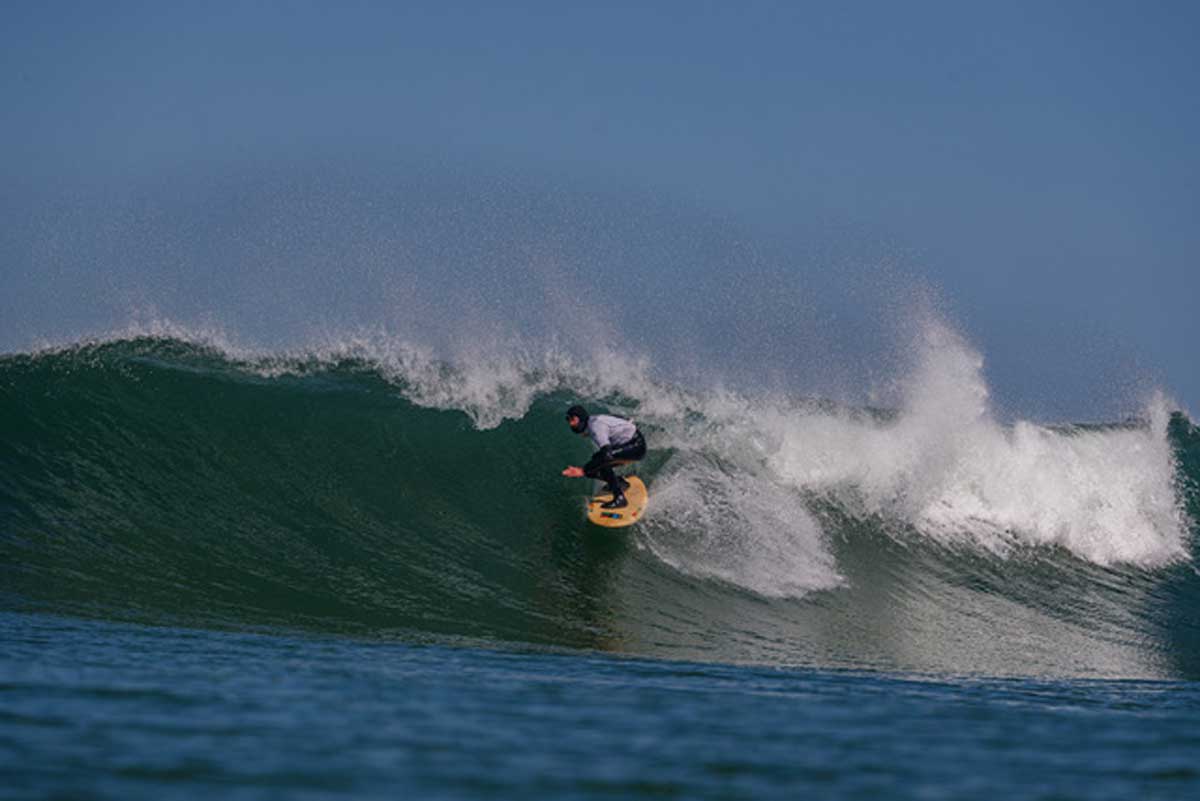
There has been an enormous outpouring of love, grief and respect this past week for 28 year old British surfer Arran Strong. Arran tragically went missing at sea in Portugal during a long distance training exercise with his longtime coach and mentor Jose Pyrrait. Arran was born with a rare genetic disorder that affected his liver and lungs but he refused to let this define him. Born in southern Spain Arran was introduced at a young age to surfing by his English Mother before moving to Portugal as a teenager. A regular competitor in the UK, Arran represented Surfing England at Junior level and then Great Britain at both the 2024 and 2025 ISA World Championships. On both occasions he was GB’s highest ranked male surfer.

Arran’s surfing came alive in heavy end sections and over the last few years he was excelling in large hollow waves and super slabs. His highlight clips from Coxos, Supertubos and Puerto Escondido are as impressive as his ISA World Championship run in 2024 where he came so close to qualifying for the Olympics with a 25th place. Back in 2022 at the WSL QS event in Azores the event was called off due to super huge storm swells all waiting period. Pretty much the whole of the tour decamped to a secret spot that was perfect but huge with 10ft freight train lefts running along the cliff line. A whole load of Europes best made excuses and watched from the rocks but a fair few gave it a paddle out having a look and surfing tentatively. Arran was in the minority that day, quietly paddling out, taking off deep and weaving lines across multiple perfect waves with confidence and skill. Arran was very much a surfers’ surfer who walked the walk. Arran was also very much a character that talked the talk. A supremely popular figure and seemingly close friend with everyone in any athlete area or core scene car park around the world. It seemed like Arran thrived on connection and it was also something that came very naturally to him. Arran was confident in himself and happy to turn up wearing a hat he bought in the backstreets of Mexico and some crazy shirt he’d grabbed from a Californian pawn shop. He was disciplined with his training routines and while others checked in on social media you may well have found him burning Palo Santo and talking about energy channels. Arran loved food and would love to cook for the whole crew around him at any opportunity helping build the human bonds that we all thrive on. He also lived a life where more than once he’d get deviated from his journey, sidetracked with some new connection and happy to disappear for some nights creating more tales for another day. Arran dedicated himself passionately to his health and wellbeing and he was ferociously fit, challenging himself to Ironman events, big wave training and long distance sea paddles at will. Following an epileptic fit in 2018 Arran had to take a whole year off surfing - his well documented resilient recovery resulted in a man keen to take and any and all opportunities in front of him.

The outpouring of love and respect online on social media this week has been broad and varied. Arran went through life with positive energy, supportive of his friends and peers and always keen to scratch deeper into conversations to understand people, places and himself more. Arran very much faced head on any challenges that he faced and he made the most of the opportunities that came his way. Arran smiled a lot and was happy and made his friends feel loved and respected and he had a lot of friends. He will be greatly missed.

He is a huge loss to our broad surfing community and our supportive thoughts are with his closest friends and family including his mother Shane and son Henry.

Following a paddle out in Portugal on Saturday a further celebratory paddle out took place on Tuesday 4th August 6pm at North Fistral.

Skindog Surfboards: OVA Surfboard Up For Grabs

Skindog Surfboards: OVA Surfboard Up For Grabs

We've teamed up with Skindog Surfboards to give away one of the most versatile mid-lengths around, the OVA.

Skindog have designed the OVA to check every box a modern mid-length needs to, with strong paddle power for busy lineups and smooth flow, glide and down the line speed. It's also built so you can turn from the middle of the board, not just off the tail. The fin setup runs to five plugs, so you can rig it as a single, a quad or a 2+1 depending on the conditions.

To find out more about the OVA, head to https://www.skindogsurfboards.co.uk/pages/ova

Rules

Entrants must follow both @carvemag and @skindog_surfboards on Instagram to qualify. UK residents only. Entries close midnight on 10th August, winner announced 11th August.

Head to our Instagram below to enter:

Drifting West – Jordy Liackman

Drifting West – Jordy Liackman

For the past few months, Jordy Liackman has been living out of a mate's caravan on the coast of Western Australia, chasing swells, working just enough to fund the next tank of fuel, and surfing every chance he got.

This isn't just another surf film. It's a time capsule from a season spent on the road, shaped by long flat spells, unforgettable sessions, breakdowns, good people, and the moments in between that rarely make the highlight reel. More than a collection of waves, it's a glimpse into the lifestyle that keeps him coming back.

Enjoy.

Carve Chats with Boardmasters Contest Director Pauly Jefferies

Carve Chats with Boardmasters Contest Director Pauly Jefferies

Interview by Joel Gray

Pauly Jefferies has been on Cornish beaches since he was a kid picking up litter at a Foster's surf event with his dad. Decades later, he's the man running the show at Boardmasters, working with the WSL to turn a stretch of Fistral into a world class competition arena. This year brings the event's biggest change yet, an upgrade to QS4000 status, pulling in a stronger international field and raising the stakes for every surfer chasing a route onto the Challenger Series. We caught up with Pauly to find out what goes into building the event from the ground up, what a typical competition day actually looks like behind the scenes, and who he's got his eye on beyond the hometown favourite.

Pauly, what is your current role at Boardmasters this year, and what was your pathway up to that?

My current role at this year's Boardmasters, and over the last three or four years, is as contest director. I work with the WSL to facilitate and deliver a top level surf event. I have to set up the infrastructure, work on the timings of the event, and the safety communications. It's a fairly comprehensive list that requires a small team behind the scenes all year round to put this in place.

Over the years, I've worked in surfing since about 1983, where I started with my dad as a litter picker at the Foster's surf event. From there, I worked with Dave Reed for many years and learned my skills, mainly as a judge. I travelled the world with the world teams and the European teams, so I got a lot of experience as I travelled, and then naturally progressed into taking over and working mainly for Surfing England as their event director over many years. That's how I got involved.

Thoughts on what the upgrade to QS4000 means?

This year's upgrade to a QS4000 is fairly significant. It's a huge opportunity to both spectators and surfers alike. With only a few events in Europe offering 4000 points and above, it's crucial for the athletes to chase these points down to progress into the Challenger Series and then the dream of making it onto the WCT. So points, any points of that amount, are worth an awful lot. It's a win-win. If you're a competitor at this year's event at 4000, you're going to get some very high level, in fact world class, surfing.

What does your role look like in the weeks leading up to the event?

My role leading up to the event is fairly mixed. We start planning for the following year pretty much the day after Boardmasters finishes. We have a debrief and then look forward to how we can improve and make things better.

Leading up to the event, I'll be looking at the surf forecast and weather patterns, and this will determine how logistically we can run and complete an event. Myself and Harriet, who is actually my right hand woman, and I probably couldn't do it without her, then work on everything from communication, staffing and infrastructure, all the way down to what healthy snacks we can put in the fridge for the 30 plus staff at the event.

Run us through a typical day for you during the event.

A typical day for me is getting up around 5am, 5.30am, normally very early, and making my way down to the beach. Once there, I meet Harriet and we fire up the coffee machine and get to work. Harriet concentrates on the communications to athletes and staff, and the socials to the general public. I'll be checking the conditions and planning my day, monitoring weather patterns to see how much we can run that day. Basically a lot of it rolls around weather and waves for me, which of course is the nature for any surfer. We follow the weather patterns, then I go about setting up for the day.

I mark out the event area, learning from how the rips are running and where the best peak is on the beach. I would have monitored that leading up to the event, and each day I'll put flags where I think the best waves will be at that tide. As the day goes on, they will move in conjunction with the tide and surf.

Once I've done that, I'll put out the rash vests for the day. There's a lot of rash vests, obviously, across many categories, so we sort those out and get them ready. Then the big boss, Rob Gunning, will turn up with his team from the WSL, and we'll discuss our thoughts on the day ahead and the day before. We make sure that as a team we're all reading from the same page before the competition commences.

The staff, media crews and technical team are there also. They'll be setting up all the replay, the actions and a lot of technical equipment in the tower, and getting that tested and ready to go. The commentators will then come in, I'll meet those, and we'll set up their notes relevant to who will be surfing that day. They like to know the plan, and they do a lot of research into individual athletes so they know what's going to happen for the day.

The head judge will also call a meeting each morning, and they'll talk about waves from the previous day or in the past to get their criteria absolutely spot on. People's careers are at stake here and they take their job extremely seriously. It's a very professional setup, and because of the technical aspects they now have, particularly at 4000 level, they're able to do recalls and call waves up, look at the scores, look at the relevancy and break down the wave. It's really important that they're all in unison as judges, looking at the same thing, which is normally set by the head judge. The head judge is a key role to all of this.

Once they're set up and ready to go, once the horn goes, the whole machine starts and off we go. Throughout the day I'll monitor every part of the setup, from beach marshals, flags and safety cover to judges, to make sure it runs as smoothly as possible. That's my main role every single day for Boardmasters.

Favourite Boardmasters memory?

I've got a couple, particularly associated with when I was young, a teenage boy watching my world idol surf on Fistral Beach. I'm a true advocate for British surfers and British surfing, so watching Russ Winter take the home win on home turf at the 2002 Boardmasters against some of the world's best surfers was definitely a highlight for me. It was judged differently then and his competition was extremely tough, and it wasn't regional. Russ is definitely an ambassador for British surfing.

In recent years, the incredibly gifted Lucas Skinner, reigning Boardmasters champ, has been a true pleasure to watch and grow into the force he has become. With the step up to a QS4000 this year, we'll hopefully see Lucas cement his place as a true WCT contender within the next few years.

Everyone will be supporting Lukas. Any other surfers who have entered you think particularly worthy of attention?

With the upgrade of the QS to a 4000 this year, Lukas is always the hometown favourite, but as it's upgraded now, you're going to attract a lot of other surfers, and we do have that. With the addition of some of the WSL Challenger surfers, we have to seriously see them as podium finishers.

The women's field also has some super talented names, including Ariane Ochoa from the Basque Country, an incredible talent who's definitely pushing towards that CT. We also have our very own Alice Barton, who qualified for the Challenger Series this year and is looking to get a great performance here on home soil. I'm sure we'll all be behind Alice to get a great result.

In the men's, the current title holder and junior global sensation Lukas Skinner is, without doubt, one to watch and the favourite for the crowd, an incredible surfer with a very promising future. But others to note include the runner-up last year to Lukas, Spain's Sean Gunning, who's already on the Challenger Series and looking for that holy grail of a CT slot. The points will mean a lot to him. We also have Guilherme Ribeiro from Portugal, sat at 19th on the Challenger Series, and a win will surely put him in a great position for a CT slot. All of the top WQS surfers are in the event, but a note from me is Germany's Zola brothers, Hans and Kai. They're exceptional talents and I'm sure they'll be pushing forward for a slot on the Challenger Series too.

What would your ideal conditions be for final day?

My ideal conditions would obviously be the classic North Beach at Fistral, with a light offshore, a solid four to six foot, and probably a nice 16 second swell period. The addition of 25 degrees with a bluebird sky would of course make the occasion a whole lot better. I'd love to see some of the best surfers surf in perfect North Fistral.

To keep up-to-date with what’s happening at Boardmasters and for ticket info:

Watermarks – Episode 2

Watermarks – Episode 2

Shipsterns Bluff is one of the heaviest slabs on the planet—and one of the defining waves of Russell Bierke’s career.

Episode 2 of Watermarks follows Russell and tow partner Zada into a monster session at Shipsterns Bluff, breaking down the wave’s infamous ledge, its warped, stepped bottom, and what it takes to ride it when the swell hits another gear. Along the way, Russell reflects on the wave’s evolution, from the fearless paddle pioneers to the modern tow era he now calls home.

Watermarks is an ongoing series exploring the waves that have shaped Russell Bierke’s career.